At a glance
RECORDED PROFILE DATA- Scientific name
- Angraecum meirax (Rchb.f.) H.Perrier
- Name status
- Accepted
- Native region
- Comoros, Madagascar
- Growth habit
- Epiphytic subshrub
- Cultivation temperature group
- Not documented
Names and Taxonomy
The accepted scientific name is Angraecum meirax (Rchb.f.) H.Perrier. The name was first published in Notulae Systematicae (Paris) 7: 120 (1938) and is accepted by Kew’s Plants of the World Online.[1] The species has a complex synonymy, reflecting its taxonomic history: Aeranthes meirax Rchb.f. (1885), Jumellea meirax (Rchb.f.) Schltr. (1915), Macroplectrum meirax (Rchb.f.) Finet (1907), Mystacidium meirax (Rchb.f.) Bolus (1889), and Pseudojumellea meirax (Rchb.f.) Szlach., Mytnik & Grochocka (2013).[4] No common names are recorded in the consulted sources.
How to Identify This Species
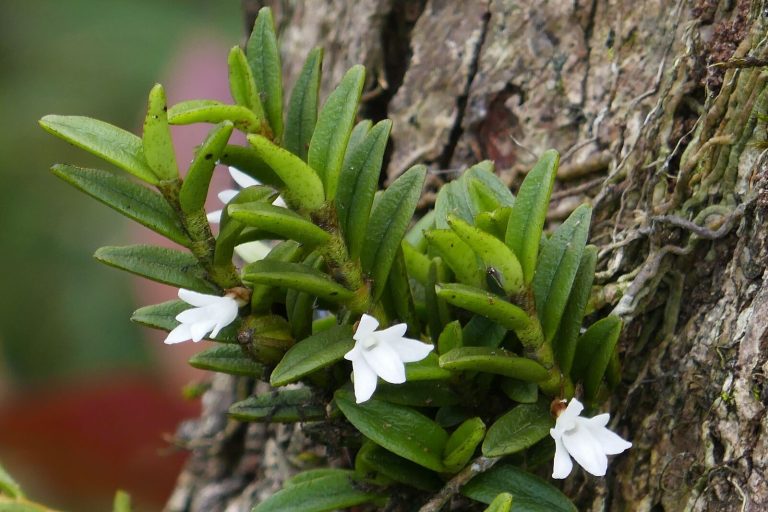
Angraecum meirax is a diminutive epiphytic subshrub. Plants reach 0–10 cm in overall height, with a short stem bearing 3–5 linear leaves measuring 22–45 mm long by 3–6 mm wide.[2] The foliage is evergreen and often clumped on the host bark.
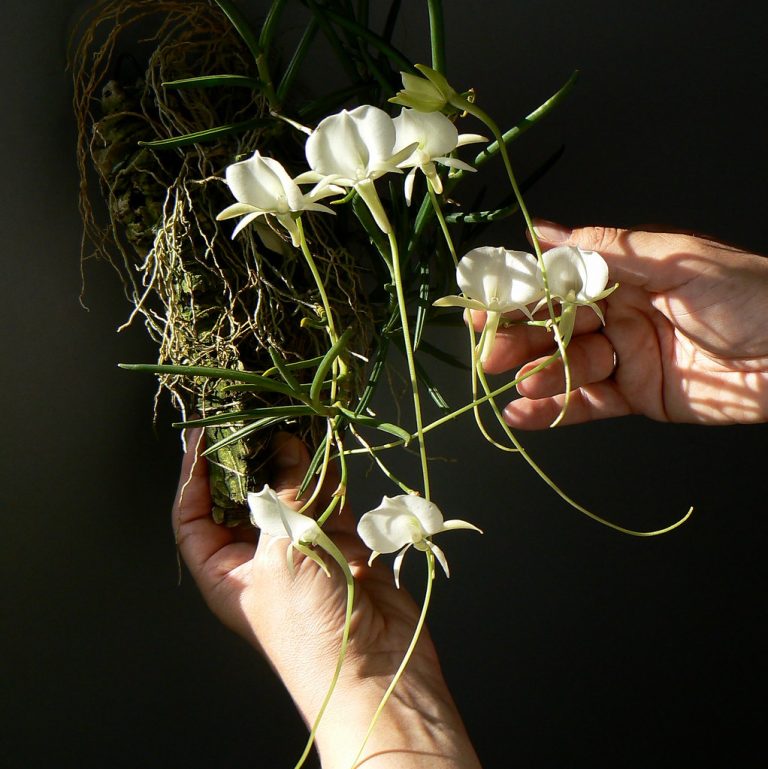
The inflorescence is a single-flowered, short peduncle that emerges from the base of the leaf cluster. Flowers are white, with a dorsal sepal and two lateral sepals that are lanceolate. The labellum (lip) is lanceolate to oval, approximately 0–40 mm long by 0–12 mm wide.[2] The most striking feature is the spur, a slender filiform tube 120–130 mm long, projecting from the back of the lip.[2]
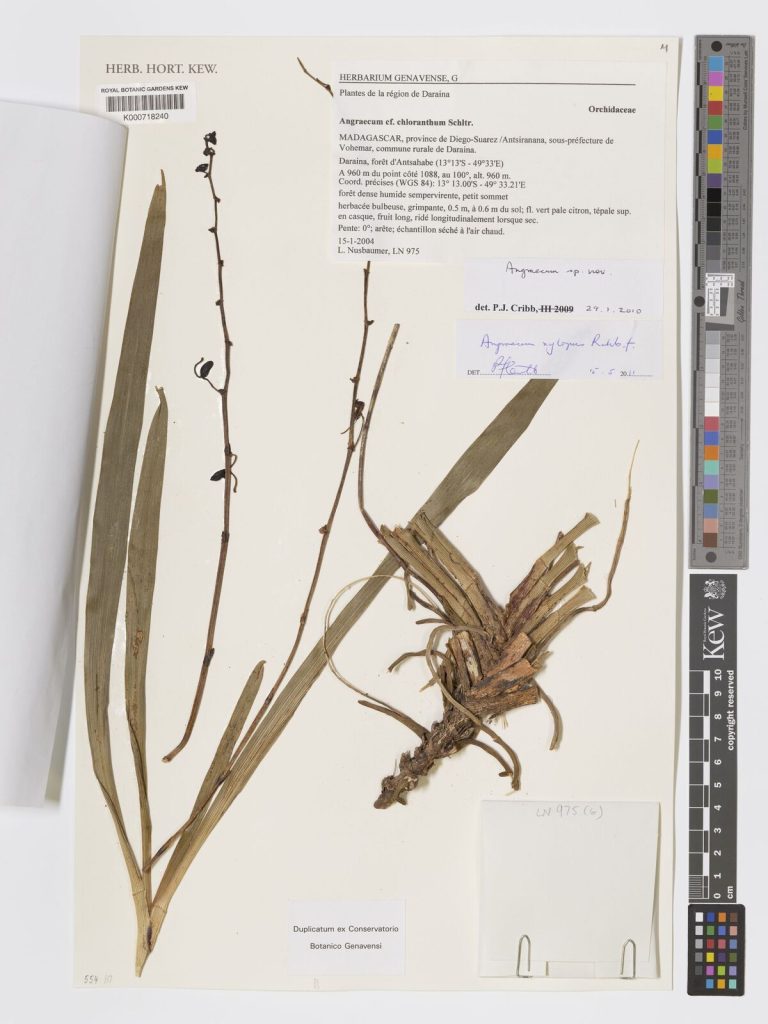
Herbarium specimens (e.g., the holotype collected at Lac de Nossi‑vé, Madagascar) confirm the short stem, linear leaves, and a single white flower with a very long spur.[3]
Native Range and Habitat
The species is native to the islands of the Comoros and Madagascar.[1] In Madagascar it has been recorded at sea‑level to about 10 m elevation, growing as an epiphyte on the trunks and branches of trees in lowland wet tropical forests.[2] The habitat is described as a “wet tropical biome”, typical of humid, forested coastal areas.
Species-Specific Care
| Factor | Documented guidance | Evidence |
|---|---|---|
| Temperature | Not documented | – |
| Light | Not documented | – |
| Watering | Not documented | – |
| Humidity | Not documented | – |
| Mounting / Potting | Not documented | – |
| Feeding | Not documented | – |
| Repotting | Not documented | – |
| Seasonal changes | Not documented | – |
Because specific horticultural information for A. meirax is absent from the consulted literature, growers should treat it as a typical lowland, epiphytic Angraecum, but any cultural regime must be considered experimental until verified by observation.
Flowering and Pollination
Flowering time, flower longevity, scent characteristics, and pollinator relationships are not recorded in the available sources for this species.
Evidence and Limitations
The profile relies on a limited set of taxonomic and morphological references. Key horticultural data (temperature, light, watering, humidity, phenology) are missing, and no peer‑reviewed studies of pollination or conservation status were found. Future field observations and cultivation trials are needed to fill these gaps.
FOLLOW THE EVIDENCE
Sources & references
- Plants of the World Online – Angraecum meirax (Rchb.f.) H.Perrier, Kew Science, 2026, https://powo.science.kew.org/taxon/urn:lsid:ipni.org:names:616257-1
- Limodore – Angraecum meirax, France Orchidees, 2026, https://limodore.france-orchidees.org/angraecum/angraecum-meirax/angraecum-meirax.html
- Muséum national d'Histoire naturelle – Holotype specimen Angraecum meirax (Rchb.f.) H.Perrier, 2026, https://science.mnhn.fr/institution/mnhn/collection/p/item/p01841460?listCount=5635255&listIndex=55
- PlantaeDB – Angraecum meirax, 2026, https://plantaedb.com/taxa/phylum/angiosperms/order/asparagales/family/orchidaceae/genus/angraecum/species/angraecum-meirax