At a glance
RECORDED PROFILE DATA- Scientific name
- Angraecum oblongifolium Toill.-Gen. & Bosser
- Name status
- Accepted
- Native region
- Madagascar
- Growth habit
- Epiphytic subshrub
- Cultivation temperature group
- Warm (24‑29 °C day, 17‑20 °C night)
Names and Taxonomy
The accepted scientific name is Angraecum oblongifolium Toill.-Gen. & Bosser, first published in Naturaliste Malgache 12:13 (1961) [1]. Kew’s Plants of the World Online lists the name as accepted and records its native range as southern‑central Madagascar [1]. A later homotypic synonym, Perrierangraecum oblongifolium (Toill.-Gen. & Bosser) Szlach., Mytnik & Grochocka, was published in 2013 but is treated as a synonym of the accepted name [3].
No universally recognised common name appears in the scientific literature. A Chinese trade site records the name “长叶万代风兰” (literally “long‑leaf Angraecum”) [12]. For English‑language growers the species is sometimes referred to as the “Oblong Leaf Angraecum”.
How to Identify This Species
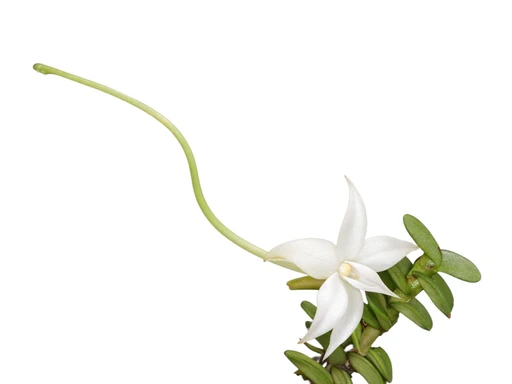
Growth habit: Small epiphytic subshrub, often pendent, reaching about 30 cm in height in the wild [7]. Stems may branch occasionally.
Leaves: Two‑ranked, oblong, leathery, 5–10 cm long (exact size not documented), apically bilobed and cordate, sometimes described as amplexicaul [5]. The leaf shape is the basis of the specific epithet.

Roots: Aerial, bearing the typical velamen of Angraecum epiphytes, attaching to bark or other host surfaces.
Inflorescence: Axillary, usually a single flower per spike, pendant, bearing a solitary white flower about 3.5 cm (1.4 in) across [5]. The flower is described as fleshy and fragrant, with a long nectar spur.
Flower details: Sepals and petals are white; the lip is rounded and may have a subtle bilobed apex. The spur is pronounced and contains nectar, a trait typical of moth‑pollinated Angraecum species [12]. Fragrance is strongest in the evening, a feature reported for many Angraecum orchids.
Because many Angraecum species share a pendant white flower, identification should be confirmed with leaf shape (oblong, bilobed) and the single‑flowered spike. Photographs lacking a clear view of the leaf base or spur may be ambiguous.
Native Range and Habitat
The species is endemic to Madagascar, with the most specific distribution recorded as southern‑central Madagascar [1]. It inhabits wet tropical forests, growing as an epiphyte on tree trunks and large branches. The habitat is described as a humid montane forest, often at elevations where cloud cover is frequent, though exact altitude limits are not documented in the available sources.
In its native setting the orchid experiences a consistently moist, warm climate with high humidity, typical of Madagascar’s eastern rainforests.
Species‑Specific Care
| Factor | Documented Guidance | Source |
|---|---|---|
| Light | Bright indirect light; 50‑70 % shade; avoid strong direct sun | [9] |
| Temperature | Warm day temperatures 24‑29 °C (75‑85 °F); night temperatures 17‑20 °C (62‑68 °F) | [9] |
| Humidity | Maintain 60‑80 % relative humidity with good air circulation | [5], [9] |
| Watering | Water thoroughly when the medium begins to dry; typical interval 4‑6 days in active growth | [9] |
| Mounting / Potting | Can be mounted on bark or grown in a well‑draining orchid mix (bark chips, charcoal, perlite). Small pots (7‑8 cm) are commonly used for trade specimens. | [9] |
| Fertilisation | Not specifically documented; standard balanced orchid fertilizer at half strength during growth is a common practice for Angraecum, but no source confirms for this species. | Not documented |
| Seasonal Rest | Some growers reduce watering in winter, but no formal rest period is recorded for this species. | Not documented |
| Airflow | Good ventilation is recommended to prevent fungal problems. | [9] |
Overall, the species prefers a warm, humid environment that mimics its native montane forest. Providing bright, filtered light and maintaining steady moisture without waterlogging are the most critical factors for healthy growth.
Flowering and Pollination
Field observations report that the plant blooms in the fall season in its native range [5]. A commercial cultivation description, however, notes flowering from spring to summer [9]. The discrepancy likely reflects variation in growing conditions or regional climate differences.
Flowers are white, fragrant, and emit scent strongest in the evening, a trait that attracts nocturnal pollinators. The long nectar spur suggests pollination by long‑tongued hawkmoths (Sphingidae), a relationship documented for many Angraecum species and specifically mentioned for A. oblongifolium in a Chinese horticultural source [12]. No direct field study of pollinator visits for this species is cited.
Conservation and Responsible Cultivation
The Angiosperm Extinction Risk Predictions (2024) list Angraecum oblongifolium as “threatened” with a confident assessment [2]. Habitat loss in Madagascar’s rainforests is a likely driver of risk.
International trade of the species is regulated under CITES Appendix II, as noted by a commercial supplier [9]. Collectors should ensure that any purchased plants are sourced from legally compliant nurseries that provide CITES documentation.
Evidence and Limitations
Most morphological and ecological details come from orchid enthusiast websites (IOSPE, NativePlants.info) and Kew’s taxonomic database. Precise measurements of leaf length, elevation range, and detailed pollinator observations are not available in the cited sources. Cultivation recommendations reflect observations from a single commercial grower and may not apply universally. Further field research would be valuable to confirm flowering phenology, exact habitat altitude, and natural pollinator identities.
FOLLOW THE EVIDENCE
Sources & references
- Angraecum oblongifolium Toill.-Gen. & Bosser | Plants of the World Online | Kew Science, https://powo.science.kew.org/taxon/urn:lsid:ipni.org:names:616301-1
- Angraecum oblongifolium Toill.-Gen. & Bosser – General Information | Plants of the World Online, https://powo.science.kew.org/taxon/urn:lsid:ipni.org:names:616301-1/general-information
- Perrierangraecum oblongifolium (Toill.-Gen. & Bosser) Szlach., Mytnik & Grochocka | Plants of the World Online | Kew Science, https://powo.science.kew.org/taxon/urn:lsid:ipni.org:names:77139226-1
- IOSPE PHOTOS – Angraecum oblongifolium, https://www.orchidspecies.com/angoblongifolium.htm
- NativePlants.info – Angraecum oblongifolium, https://www.nativeplants.info/plant/magnoliophyta-flowering-plants/orchidaceae/angraecum/angraecum_oblongifolium.html
- Ecuagenera – Angraecum oblongifolium product page, https://ecuagenera.com/products/angraecum-oblongifolium
- Tropicals.cn – Angraecum oblongifolium (长叶万代风兰), https://tropicals.cn/species/angraecum-oblongifolium

