At a glance
RECORDED PROFILE DATA- Scientific name
- Angraecum magdalenae var. magdalenae
- Name status
- Accepted variety (POWO)
- Native region
- Central Madagascar
- Growth habit
- Lithophytic subshrub
- Cultivation temperature group
- Cool (day 23‑25 °C, night 13‑14 °C)
Names and Taxonomy
The accepted name for this taxon is Angraecum magdalenae var. magdalenae. It was first described as the species Angraecum magdalenae by Rudolf Schlechter & H. Perrier in 1925 and later recognised at the varietal rank by the Kew World Checklist (see POWO [1]). The variety is accepted and listed as a distinct infraspecific taxon under the species Angraecum magdalenae (POWO [2]). No other scientific synonyms are recorded for the variety itself; the species has the synonym Rudolfangraecum magdalenae (Schltr. & H.Perrier) Szlach., Mytnik & Grochocka [3]. No common name is documented in the available sources.
How to Identify This Species
Field reports describe the plant as a medium‑sized, monopodial lithophyte growing on quartzite boulders. Stems are short and the leaves are arranged distichously, each leaf 6–8 in number, fleshy‑coriaceous, oblong‑ligulate and unequally bilobed at the apex (IOSPE [3]).
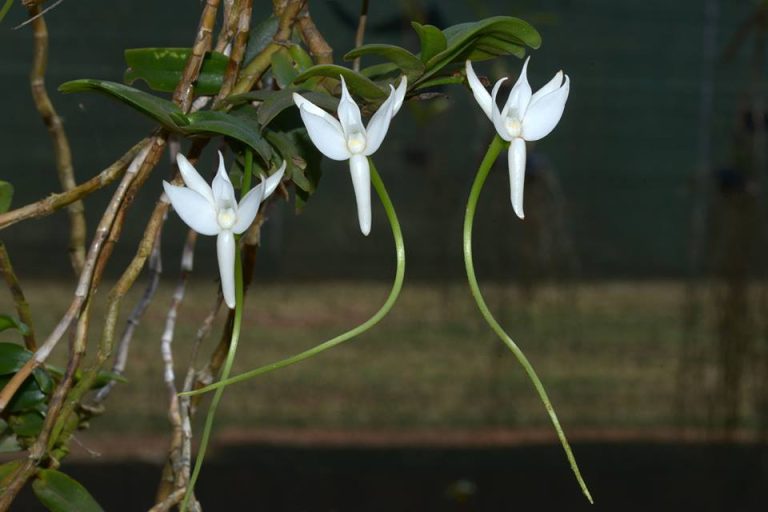
The inflorescence is a short, bracteate spike 2–3 cm long, arising from below the first leaf and bearing 1–5 flowers. Flowers are strikingly white, 7.5–10 cm across, with a long tubular spur about 10 cm in length. The fragrance is described as sweet, jasmine‑like and strongest at night. These characters—large white flowers with an exceptionally long spur and a nocturnal fragrance—help separate the taxon from other Angraecum species that have shorter spurs or different colouration.
Because the variety shares the same basic flower morphology as the species, identification relies on the lithophytic habit and the central‑Madagascar distribution rather than on unique floral traits.
Native Range and Habitat
The variety is endemic to central Madagascar, where it occurs in the seasonally dry tropical biome (POWO [1]). In the wild it grows lithophytically on quartzite boulders, often in leaf litter, at elevations between 800 m and 2000 m. The habitat experiences a distinct cool, dry winter season with minimal rainfall (about 1.2 cm per month) and mist that provides limited moisture (IOSPE [3]).
Species‑Specific Care
| Factor | Documented guidance | Source |
|---|---|---|
| Light | Bright, 3000–4500 fc; can tolerate near‑full sun if airflow is strong | African Orchids [4] |
| Temperature | Day 23–25 °C (74–76 °F); night 13–14 °C (56–57 °F); diurnal range ~10 °C | African Orchids [4] |
| Humidity | Moderate; mist present in native habitat, avoid prolonged saturation | Not documented – inferred from habitat description (IOSPE [3]) |
| Watering | Keep roots damp but never soggy; reduce watering during the cool, dry season | Not documented – general practice for lithophytic orchids |
| Medium | Shallow, well‑drained mix; recommended 5 parts fine fir bark, 3 parts perlite, 1 part chopped sphagnum moss (as suggested for Angraecums) | Not documented for this variety – based on generic Angraecum guidance (Hillerman [10]) |
| Mounting | Can be grown in a shallow pot or mounted on rock with ample airflow | Not documented – logical for lithophytic habit |
| Fertilisation | Balanced orchid fertilizer at half strength during active growth | Not documented – standard practice |
| Rest period | Cool, drier conditions in winter mimic native dry season | Not documented – inferred from native climate |
In practice, growers report that the species tolerates bright light and benefits from good air movement, which helps prevent leaf scorch when exposed to higher irradiance. Maintaining a cool night temperature (around 13 °C) is critical for encouraging growth and eventual flowering.
Flowering and Pollination
Plants flower in the later spring to early summer of the Southern Hemisphere, coinciding with the end of the cool, dry season (IOSPE [3]). Flowers open at night, emit a strong jasmine‑like fragrance, and remain viable for several days. The long spur (≈10 cm) suggests pollination by long‑tongued hawkmoths, a pattern common in many Angraecum species, but direct pollinator observations for this variety are not documented in the available sources.
Evidence and Limitations
The profile relies on a limited set of sources: Kew’s Plants of the World Online for taxonomic status and native range; IOSPE for morphological and ecological notes; and a cultivation note from African Orchids for temperature and light requirements. Several horticultural aspects (exact humidity levels, fertilisation regime, detailed pest management) lack species‑specific documentation and are therefore presented as general Angraecum guidance or marked “Not documented.” No formal conservation assessment (e.g., IUCN) was found for the variety.
Frequently asked questions
What light level does Angraecum magdalenae var. magdalenae need?
Bright light of 3000–4500 foot‑candles is recommended; the plant can tolerate near‑full sun if good airflow is provided (African Orchids [4]).
What temperature range is suitable for this variety?
Daytime temperatures of 23–25 °C (74–76 °F) with cool nights of 13–14 °C (56–57 °F) mimic its natural high‑elevation habitat (African Orchids [4]).
When does this orchid typically flower?
Flowering occurs in the later spring to early summer of the Southern Hemisphere, after the cool, dry season (IOSPE [3]).
FOLLOW THE EVIDENCE
Sources & references
- Angraecum magdalenae var. magdalenae | Plants of the World Online | Kew Science, https://powo.science.kew.org/taxon/urn:lsid:ipni.org:names:77167503-1
- Angraecum magdalenae Schltr. & H.Perrier | Plants of the World Online | Kew Science, https://powo.science.kew.org/taxon/urn:lsid:ipni.org:names:616244-1
- IOSPE PHOTOS – Angraecum magdalenae, https://www.orchidspecies.com/angmagdalenae.htm
- Cultivation of Angraecum magdalenae – African Orchids, http://www.africanorchids.dk/?catid=299angraecum&id=3595cultivation-of-angraecum-magdalenae-schltr-h-perrier&view=article
- Cultural Requirements of Angraecum by Fred E. Hillerman, https://docslib.org/doc/9024324/cultural-requirements-of-angraecum-by-fred-e-hillerman