At a glance
RECORDED PROFILE DATA- Scientific name
- Angraecum equitans Schltr.
- Name status
- Accepted
- Native region
- Northern Madagascar
- Growth habit
- Epiphytic subshrub, miniature, equitant leaves
- Cultivation temperature group
- Cool (≈10‑18 °C)
Names and Taxonomy
Angraecum equitans Schltr. is the accepted name for this species according to Kew’s Plants of the World Online.1 It was first described in Beihefte zum Botanischen Centralblatt 34(2): 339 in 1916.2 A later homotypic synonym, Humblotiangraecum equitans (Schltr.) Szlach., Mytnik & Grochocka, was published in 2013 but is treated as a synonym of A. equitans by POWO.1
The species is listed as Accepted in the World Checklist of Vascular Plants and carries the author citation “Schltr.” indicating Rudolf Schlechter as the original describer.
How to Identify This Species
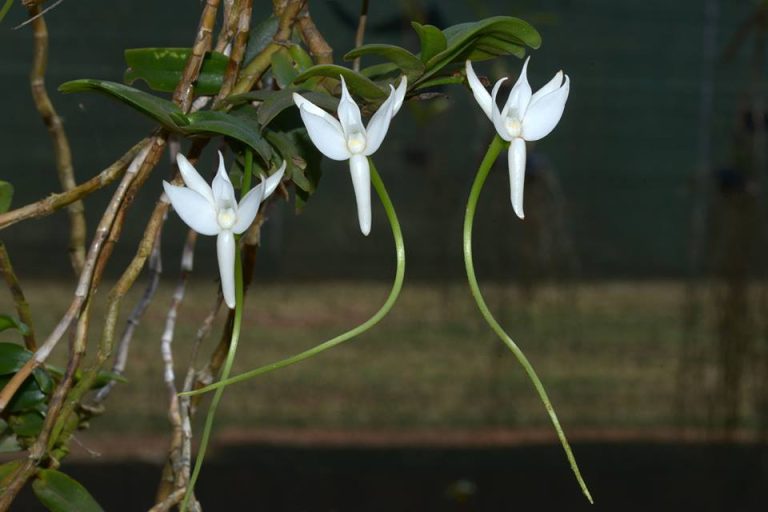
Angraecum equitans is a miniature epiphytic subshrub. Mature plants form a compact, branched stem that may be several centimetres tall but rarely exceeds 10 cm in overall height. The leaves are densely packed, equitant (overlapping in a fan‑like arrangement), fleshy, dark‑green, curved, somewhat glossy and obtusely bilobed.4 This leaf morphology gives the plant a geometric, rosette‑like appearance.
The inflorescence is 7–8 cm long, bearing one to three flowers that are completely hidden by tightly folded bracts until they open. Flowers are white, sized 3.5–5.5 cm (1 2/5″–2 1/5″) in length, and lack the long pendant spikes typical of many larger Angraecums. The lip is modest, and the nectar spur is short, matching the modest flower size.4 The species blooms in late spring in its native range.9
Because many Angraecum species share small white flowers, leaf arrangement and growth habit are the most reliable field characters. The combination of high‑elevation lichen‑forest habitat, equitant leaves, and a short, bract‑enveloped inflorescence distinguishes A. equitans from similar taxa such as A. stella‑africa or A. candidum, which typically have longer, more pendant spikes.
Native Range and Habitat
The species is endemic to northern Madagascar, where it occurs in wet tropical biomes.1 Field observations place it on the slopes of the Tsaratanana Massif at elevations around 2000 m, growing as an epiphyte on the outer branches of moss‑ and lichen‑covered trees in lichen forest.49 The habitat is characterised by high humidity, frequent cloud cover, and a cool to cold microclimate due to altitude. Light conditions are bright but filtered by the forest canopy, and the plants often receive almost full sun on exposed branch tips.
Species-Specific Care
| Factor | Documented guidance | Evidence |
|---|---|---|
| Light | 8000–15000 lux; filtered or diffused light; avoid direct midday sun. | 9 |
| Temperature | Cool to cold conditions, roughly 10–18 °C (50–64 °F) mimicking 2000 m altitude. | 4 |
| Humidity | Moderate to high humidity; maintain air moisture but allow good airflow. | 9 |
| Watering | Keep the potting medium lightly moist; avoid waterlogging. In the wild the plant receives frequent mist from cloud cover. | 4 |
| Air movement | Provide constant gentle airflow to prevent fungal buildup. | 9 |
| Mounting / Potting | Can be mounted on bark or grown in a coarse orchid mix (bark, sphagnum, perlite). Mounting reflects its natural epiphytic habit. | 4 |
| Fertilisation | Apply a balanced, water‑soluble orchid fertilizer at half strength every 2–3 weeks during active growth. | 9 |
| Repotting / Re‑mounting | Refresh mount or potting medium every 2–3 years or when roots outgrow the support. | 9 |
Because the species originates from cool, high‑elevation forests, it does not tolerate prolonged high temperatures above 22 °C. In cultivation, placing the plant in a cool greenhouse, a well‑ventilated indoor setting, or a shaded outdoor mount in temperate climates is advisable. Over‑watering is a common cause of failure; the medium should dry slightly between waterings.
Flowering and Pollination
In its native habitat, A. equitans flowers in late spring (approximately October–November in the Southern Hemisphere). Individual flowers last several weeks, though precise longevity has not been documented.9 The flowers are scentless in the sources consulted; any fragrance characteristics remain unrecorded.
No specific pollinator has been identified for this species in the literature. The modest, short-spurred white flowers suggest possible moth or small fly pollination, but this remains speculative.
Conservation and Responsible Cultivation
The International Union for Conservation of Nature (IUCN) classifies Angraecum equitans as Vulnerable (VU).3 Threats include habitat loss from deforestation and climate change affecting high‑altitude cloud forests. Collectors are urged to obtain plants from reputable, legally compliant sources that propagate from seed or tissue culture rather than wild collection.
Evidence and Limitations
Key aspects such as precise temperature tolerances, flower fragrance, and confirmed pollinators are not documented in the available sources. The care recommendations are based on observations from growers and the species’ high‑elevation habitat, and may need adjustment for individual greenhouse conditions. Further field studies would be valuable for confirming pollination biology and detailed phenology.
Frequently asked questions
What light level does Angraecum equitans need in cultivation?
The species prefers bright, filtered light of about 8000–15000 lux and should be protected from direct midday sun. This recommendation comes from grower observations documented on a dedicated orchid blog.9
Is Angraecum equitans considered a threatened species?
Yes. The IUCN Red List classifies Angraecum equitans as Vulnerable (VU), reflecting concerns about habitat loss in its limited high‑elevation range in northern Madagascar.3
Can Angraecum equitans be mounted on bark, or does it require a pot?
Both mounting on bark and growing in a coarse orchid mix are acceptable. The plant is naturally epiphytic, and growers recommend either method to imitate its wild habit.4
FOLLOW THE EVIDENCE
Sources & references
- Angraecum equitans Schltr. – Plants of the World Online, Kew Science, 2026, https://powo.science.kew.org/taxon/urn:lsid:ipni.org:names:616109-1
- Angraecum equitans – International Plant Names Index, https://www.ipni.org/n/616109-1
- Angraecum equitans – IUCN Red List of Threatened Species, Vulnerable, https://www.iucnredlist.org/species/70102289/70138429
- Angraecum equitans – IOSPE Orchid Photos, https://www.orchidspecies.com/angequitans.htm
- Angraecum equitans – Travaldo's blog, Orchid plant care and culture, https://travaldo.blogspot.com/2018/09/angraecum-equitans-orchid-plant-care-and-culture.html