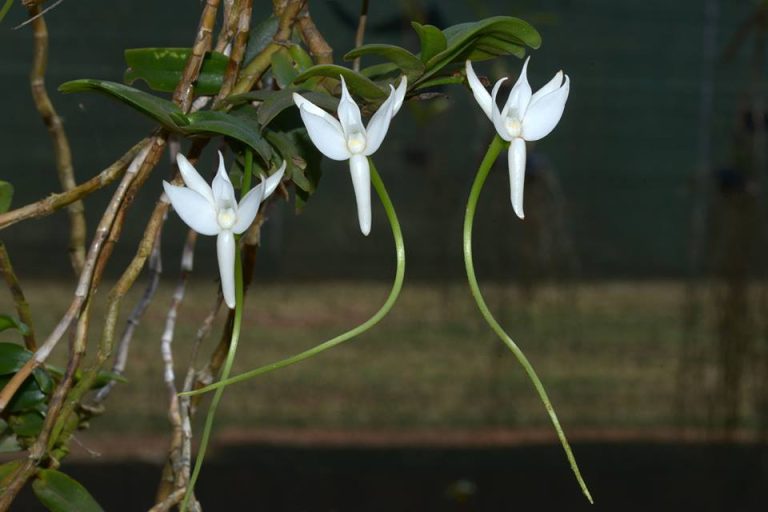
At a glance
RECORDED PROFILE DATA- Scientific name
- Angraecum elliotii Rolfe
- Name status
- Accepted
- Native region
- Madagascar
- Growth habit
- Epiphytic subshrub (epiphyte on moss‑covered trunks)
- Cultivation temperature group
- Cool to warm (reported as cool growing at 1200 m; also described as warm growing)
- Flower colour
- White
- Typical flower size
- ≈2.5 cm across
Names and Taxonomy
The accepted scientific name is Angraecum elliotii Rolfe, first published in Journal of the Linnean Society, Botany 29:54 (1891) [1]. Kew’s Plants of the World Online lists the name as accepted and records its native range as central and southeastern Madagascar.
Synonym: Angraecoides elliotii (Rolfe) Szlach., Mytnik & Grochocka, published in 2013 [2]. The common name recorded in horticultural literature is “Elliot’s Angraecum” [2].
How to Identify This Species
Growth habit: A pendent epiphytic subshrub that clings to moss‑ and lichen‑covered tree trunks. Stems are slender, often 15–20 cm long, bearing thin roots [4]. Mature plants reach about 30 cm in height [3].
Leaves: Two‑ranked, linear‑lanceolate, apically short‑pointed; spaced along the stem.
Inflorescence: Axillary, single‑flowered, arising from the leaf axil.
Flower: White, fragrant, approximately 2.5 cm (1 in) across [2]. The lip is short, with a relatively long nectar spur typical of many Angraecum species. No distinctive markings beyond the pure white coloration are documented.
Because many Angraecum species share a similar habit, identification should be confirmed by the combination of stem length, leaf shape, and the single white flower size.
Native Range and Habitat
Angraecum elliotii is endemic to Madagascar, specifically the central and southeastern highlands [1]. It grows as an epiphyte on trunks covered with moss and lichens, typically at elevations between 1 000 and 2 100 m [4]. The species favours wet tropical forest micro‑habitats, often in areas with high humidity and frequent mist.
Species‑Specific Care
| Factor | Documented guidance | Source |
|---|---|---|
| Light | Medium light; bright but filtered (similar to forest understory) | [4] |
| Temperature | Cool to warm; growers report success in intermediate‑to‑cold greenhouses (cool growing at 1 200 m) and also as a warm‑growing orchid in cultivation. | [5][4] |
| Humidity | High (≥70 %); consistent moisture mimicking moss‑laden trunks. | [4] |
| Watering | Frequent watering to keep medium moist; allow brief drying between waterings, avoid water‑logging. | [4] |
| Mounting / Potting | Often mounted on bark or grown in a well‑draining epiphytic mix (e.g., bark, sphagnum, perlite). | [4] |
| Fertilising | Balanced orchid fertilizer at half strength weekly during active growth. | [4] |
| Repotting / Re‑mounting | Repot or re‑mount when the medium breaks down, typically every 2–3 years. | [4] |
| Seasonal changes | Some growers reduce watering in winter; no formal rest period documented. | [4] |
Overall, the species prefers conditions that reproduce its native cool, humid forest niche: bright filtered light, high humidity, and a well‑aerated medium that stays moist but not soggy. Temperature ranges are not precisely documented; growers report success in both intermediate (≈18–24 °C day) and cooler (≈12–18 °C night) regimes.
Flowering and Pollination
In the wild, flowering occurs from October to March [4]. In cultivation, flowering has been observed from March to April in temperate greenhouses [4]. Individual flowers last several weeks and emit a noticeable fragrance, especially in the evening.
No specific pollinator has been recorded for A. elliotii; the long nectar spur suggests moth pollination, a common trait in the genus, but this remains a hypothesis pending field observation.
Evidence and Limitations
Most morphological and ecological data come from horticultural descriptions and regional orchid listings. Precise temperature tolerances, pollinator identities, and conservation assessments are not documented in the available sources. Further field studies are needed to confirm pollination biology and to evaluate the species’ IUCN status.
FOLLOW THE EVIDENCE
Sources & references
- Angraecum elliotii Rolfe | Plants of the World Online | Kew Science, https://powo.science.kew.org/taxon/urn:lsid:ipni.org:names:616104-1
- IOSPE PHOTOS – Angraecum elliotii, https://www.orchidspecies.com/angelliotii.htm
- Angraecum elliotii | NativePlants.info, https://www.nativeplants.info/plant/magnoliophyta-flowering-plants/orchidaceae/angraecum/angraecum_elliotii.html
- page A4 – Madaorchidee, http://madaorchidee.free.fr/lesorchideesdemadagascar/pagesalphabetiques/pageA4.htm
- Angraecum elliotii – orchid.guru, https://orchid.guru/content/orchids/a/angraecum/