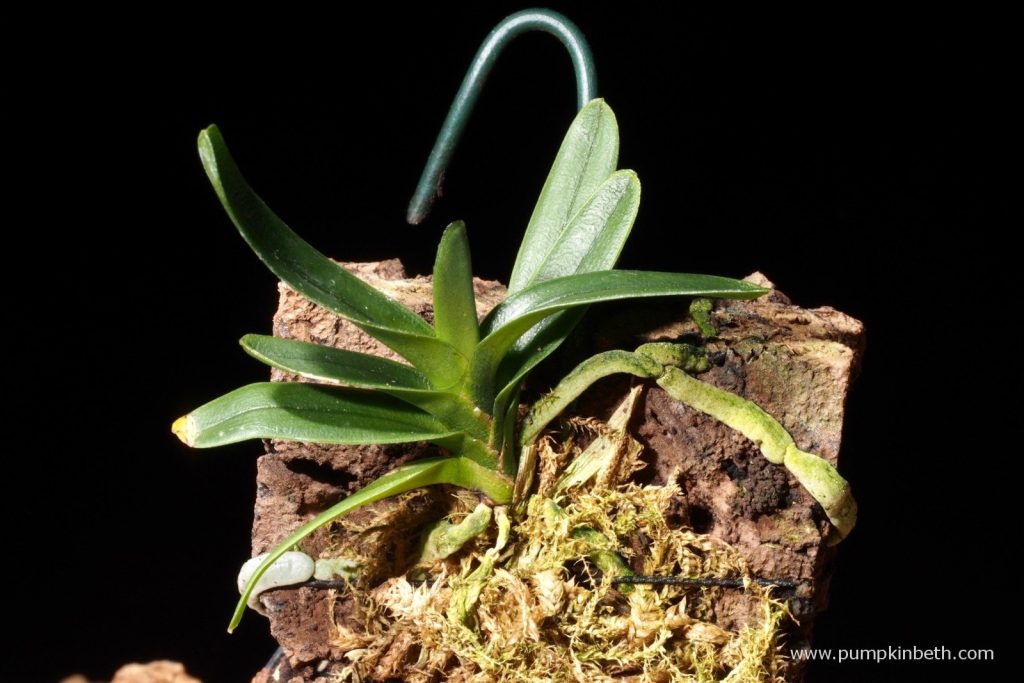
At a glance
RECORDED PROFILE DATA- Scientific name
- Angraecum dollii Senghas 1997
- Name status
- Accepted
- Native region
- Madagascar
- Growth habit
- Epiphytic, pendant miniature
- Cultivation temperature group
- Warm to intermediate
Names and Taxonomy
The accepted name for this species is Angraecum dollii Senghas 1997. It was described as a new species from Madagascar in Senghas (1997) and placed in the section Perrierangraecum【1】. No synonymy or spelling variants are recorded in the consulted sources. The common name reported in horticultural literature is “Doll’s Angraecum”【2】.
How to Identify This Species
Growth habit: A miniature pendant epiphyte, typically 30 cm tall in cultivation, with a short, often hanging stem and a compact rosette of leaves【5】.
Leaves: Well‑spaced, spreading, coriaceous leaves that are “V”‑conduplicate, unequally bilobed at the apex and semi‑terete in cross‑section【2】.
Inflorescence: Axillary, single‑flowered, about 3 cm long, bearing 2–3 short, tubular black bracts and a thin brown floral bract【2】.
Flower: White, fragrant, up to 8 cm (3.2 in) long, with a noticeable spur (exact length not specified)【2】. The flower is relatively large compared with the plant size, a useful diagnostic feature.
Comparison: It may be confused with other small Malagasy Angraecums such as A. drouhardii, but the combination of pendant habit, V‑conduplicate leaves, and a single large white flower with a spur helps separate it.
Native Range and Habitat
Endemic to Madagascar, chiefly in the central highlands around Antsirabe, Antananarivo and Fianarantsoa【4】. It grows as an epiphyte on trunks and branches in forests that experience a distinct dry season in winter. Elevation is reported at approximately 1,000 m (3,300 ft)【2】【4】. The species prefers trees whose bark is covered with lichens and small shrubs, indicating a relatively open, seasonally dry forest canopy.
Species‑Specific Care
| Factor | Documented guidance | Source |
|---|---|---|
| Light | Medium light, roughly 10,000–15,000 lux | 4 |
| Temperature | Warm to intermediate (often described as “medium” or “intermediate‑warm”) | 6 |
| Watering (summer) | Generous watering; keep the medium moist | 4 |
| Watering (winter) | Reduced watering, approximately once every 10–15 days | 4 |
| Mounting / potting medium | Pot: medium bark mix with a little chopped sphagnum; Mount: bark with minimal sphagnum so roots dry quickly | 4 |
| Humidity | Not documented | |
| Fertilisation | Not documented | |
| Rest period | Not documented; growers do not report a mandatory dry rest | 6 |
In practice, growers mount the plant on a cork or wood slab, allowing excellent airflow, or keep it in a well‑draining bark pot. Provide bright, filtered light and avoid direct midday sun. Maintain warm daytime temperatures (around 22–28 °C) and cooler nights (around 16–20 °C), matching the “warm to intermediate” description. Water heavily during the active growth phase and taper in the cooler, drier months, following the 10–15 day interval noted for winter watering. No specific humidity target is published for this species; a typical orchid greenhouse humidity of 50–70 % is likely adequate.
Flowering and Pollination
Flowering has been reported throughout the year in cultivation, with plants observed in bloom in every month (January–December)【5】. Flowers are fragrant, a trait that often indicates moth pollination in Angraecums, but no pollinator has been documented for A. dollii. The spur suggests adaptation to a long‑tongued pollinator, yet direct observations are lacking.
Evidence and Limitations
Most information on Angraecum dollii derives from horticultural descriptions and a limited number of field notes. Key gaps include precise measurements of the nectar spur, documented pollinators, conservation status, and detailed humidity or fertilisation regimes. Further field research and formal conservation assessments are needed to fill these gaps.
FOLLOW THE EVIDENCE
Sources & references
- Angraecum – American Orchid Society (AOS) overview, includes reference to Senghas 1997 description of Angraecum dollii. https://www.aos.org/explore/angraecum
- IOSPE PHOTOS – Angraecum dollii Senghas 1997. https://www.orchidspecies.com/angdollii.htm
- AOS article PDF – Angraecum dollii collector’s item (May 2015). https://botanicaltd.com/wp-content/uploads/2022/12/aos-angraecum-dollii-may2015-oviatt-nerison-1.pdf
- Orchidees‑Angraecoid blog – Angraecum dollii, Senghas 1997 (culture notes). http://orchidees-angraecoid.blogspot.com/2016/02/angraecum-dollii-senghas-1997.html
- NativePlants.info – Angraecum dollii profile. https://www.nativeplants.info/plant/magnoliophyta-flowering-plants/orchidaceae/angraecum/angraecum_dollii.html
- Celaorchidee – Angraecum dollii product description (temperature info). https://celaorchidee.it/products/angraecum-dollii
- Seattle Orchid – Angraecum dollii product page (cultivation notes). https://www.seattleorchid.com/Angraecum-dollii-p/tsangr-dollii.htm

