At a glance
RECORDED PROFILE DATA- Scientific name
- Angraecum curvicaule Schltr.
- Name status
- Accepted
- Native region
- Madagascar
- Growth habit
- Epiphytic subshrub
- Cultivation temperature group
- Not documented
Names and Taxonomy
Angraecum curvicaule Schltr. is the accepted name for this orchid. The name was first published in 1925 (Repert. Spec. Nov. Regni Veg. Beih. 33: 346) and is listed as accepted by Kew’s Plants of the World Online [1]. A later homotypic synonym is Angraecoides curvicaulis (Schltr.) Szlach., Mytnik & Grochocka, created when the species was transferred to the segregate genus Angraecoides [1][2]. No common names are recorded in the consulted sources.
How to Identify This Species
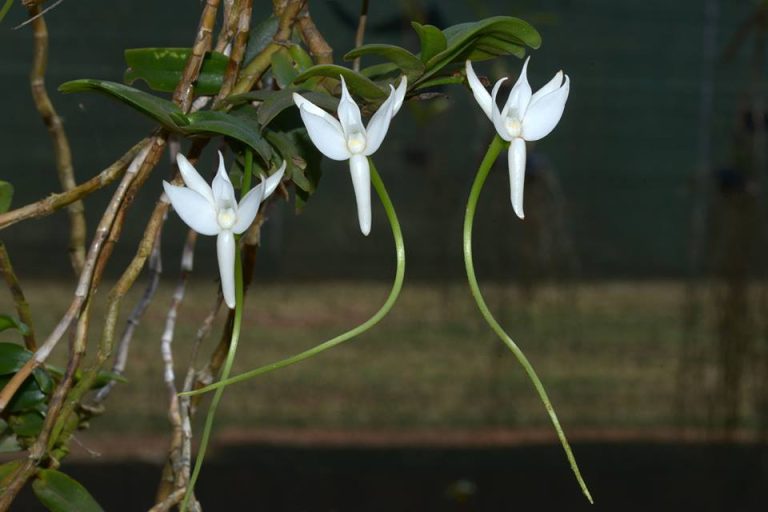
This species is a medium‑sized epiphytic subshrub that typically reaches about 30 cm in height [3]. It bears a thin, stiff stem that carries linear‑ligulate (strap‑like) leaves. The inflorescence is a short raceme, 3–5 cm long, usually bearing two flowers [2]. Flowers are white to greenish‑white, fragrant, and the plant is reported to bloom throughout the year in cultivation [3]. Detailed measurements of the lip and spur are not provided in the available excerpts, so a definitive floral diagnosis requires examination of a specimen or a full description.
Native Range and Habitat
Angraecum curvicaule is endemic to the eastern side of Madagascar, with most records indicating the north‑eastern region [1][4]. It grows as an epiphyte in wet tropical forests, often at elevations of 900 m and higher [2]. The species prefers humid, rain‑rich environments typical of the island’s eastern escarpment.
Species‑Specific Care
| Factor | Documented guidance | Evidence |
|---|---|---|
| Growth habit | Epiphytic; best mounted or grown in a hanging basket with minimal root disturbance | [3][5] |
| Light | Bright to intermediate light, mimicking forest canopy | [5] |
| Temperature | Warm conditions typical of low‑land eastern Madagascar; precise limits not documented | Not documented |
| Watering | Frequent watering to keep the medium moist, similar to heavy rainfall; allow the medium to dry slightly between waterings | [4][5] |
| Humidity | Maintain ≥70 % relative humidity | [3] |
| Fertiliser | Balanced fertilizer at half strength once a week during active growth | [5] |
| Repotting / mounting | Repot only when necessary; use a bark‑based medium or mount on cork/bark; avoid disturbing roots | [5] |
| Seasonal change | No specific rest period recorded; continue care year‑round | Not documented |
Growers report that the species tolerates low drought stress and benefits from regular feeding and high humidity, reflecting its native wet forest habitat [3][4]. Because precise temperature thresholds are not published, a common practice for warm‑growing Angraecum species is to maintain daytime temperatures of 24–30 °C and night temperatures of 18–22 °C, adjusting as needed based on plant response.

Flowering and Pollination
Flowering has been observed throughout the year in cultivation, with white‑greenish fragrant flowers [3]. No specific data on flower longevity, natural pollinators, or pollination mechanisms are available in the consulted sources.
Evidence and Limitations
The profile draws on taxonomic data from Kew’s Plants of the World Online, a brief horticultural description from IOSPE, and general Angraecum care guidelines. Detailed morphological measurements (e.g., spur length, lip shape), precise temperature ranges, and pollination biology are not documented in the available excerpts. Further field studies or access to the original species description would be required to fill these gaps.
Frequently asked questions
What light conditions does Angraecum curvicaule need?
The species prefers bright to intermediate light, similar to the filtered light it receives in a forest canopy. This recommendation is based on general Angraecum care guidelines [5].
How high should humidity be for Angraecum curvicaule?
Maintain relative humidity at 70 % or higher. This threshold is reported for the species in cultivation data [3].
FOLLOW THE EVIDENCE
Sources & references
- Angraecum curvicaule Schltr. | Plants of the World Online | Kew Science – https://powo.science.kew.org/taxon/urn:lsid:ipni.org:names:616065-1
- IOSPE PHOTOS – Angraecum curvicaule Schltr. 1925 – http://www.orchidspecies.com/angcurvicaule.htm
- Angraecum curvicaule (Angraecum curvicaule) | NativePlants.info – https://www.nativeplants.info/plant/magnoliophyta-flowering-plants/orchidaceae/angraecum/angraecum_curvicaule.html
- Angraecum Orchids, Orchid Care, Orchid Compendium – http://www.clanorchids.com/compendium/page3a.html
- Growers guides | Angraecum – http://www.capeorchidsociety.co.za/wp-content/uploads/2019/06/Angraecum.pdf