At a glance
RECORDED PROFILE DATA- Scientific name
- Angraecum coutrixii Bosser
- Name status
- Accepted
- Native region
- Madagascar (south‑central)
- Growth habit
- Lithophytic subshrub (occasionally epiphytic)
- Cultivation temperature group
- Cool
Names and Taxonomy
Angraecum coutrixii Bosser is the accepted name for this species according to Kew’s Plants of the World Online (POWO) [1]. It was first published in Adansonia n.s., 10:107 (1970). A later homotypic synonym is Pseudojumellea coutrixii (Bosser) Szlach., Mytnik & Grochocka [1]. No vernacular common name is documented in the available sources.
How to Identify This Species
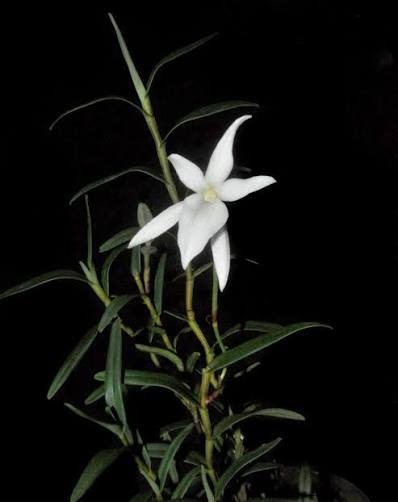
The plant is a miniature lithophytic subshrub that often appears as an erect, slightly flattened reed‑like cane up to 11 cm tall (AOS [2]). Leaves are linear, slightly conduplicate, 0.2 cm wide and up to 2 cm long, arranged alternately along the cane (AOS [2]). The pseudobulb is 11 cm long and 0.2–0.3 cm wide (AOS [2]).
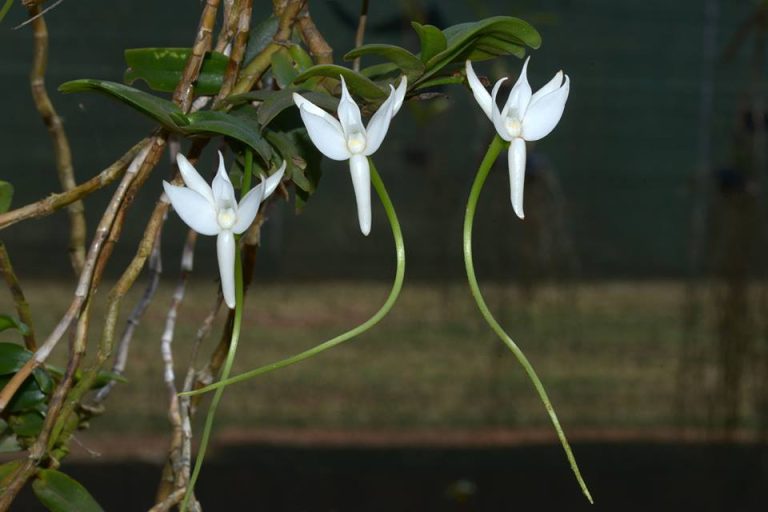
Flowers are solitary or in a 1–2‑flowered inflorescence 3.5 cm long (AOS [2]; IOSPE [5]). Sepals and petals are lanceolate, white, and approximately 2–4 cm in total length (IOSPE [5]). The lip is ovate‑spatulate, slightly concave, and the spur is unusually long – about 4 cm long and 0.1 cm wide, white at the base turning chartreuse distally (AOS [2]; IOSPE [5]). The flower emits a faint fragrance, though intensity is not quantified.
Because several Angraecum species share small, white, spur‑bearing flowers, confirmation should be based on the combination of leaf size, cane dimensions, and the exceptionally long spur relative to plant size.
Native Range and Habitat
The species is native to south‑central Madagascar, occurring in the seasonally dry tropical biome and recorded at elevations of roughly 1 400–1 650 m (POWO [1]; IOSPE [5]). In the wild it grows as a lithophyte on rocks, but some observations describe it as an epiphyte on trees in cool, montane forests (IOSPE [5]). The habitat experiences a distinct dry season and cooler temperatures due to altitude.
Species‑Specific Care
| Factor | Documented guidance | Evidence |
|---|---|---|
| Growth medium | Well‑draining bark mix in a clay pot | AOS grower report [2] |
| Potting / mounting | Suitable for pot culture; can also be mounted on bark | AOS grower report [2]; IOSPE description of epiphytic habit [5] |
| Temperature | Cool conditions, similar to its native montane environment | IOSPE describes it as a “cool growing” epiphyte [5] |
| Light | Not documented | — |
| Watering | Not documented | — |
| Humidity | Not documented | — |
| Fertilisation | Not documented | — |
| Seasonal rest | Not documented | — |
Growers who have successfully cultivated A. coutrixii report using a fine‑barked orchid mix that remains dry between waterings, mimicking its lithophytic habit (AOS [2]). Because the species originates from cool, high‑elevation sites, maintaining daytime temperatures around 18–24 °C and night temperatures not dropping below 12 °C is advisable, though precise thresholds are not published.
Flowering and Pollination
In cultivation the plant flowers in the summer months (southern‑hemisphere summer) and produces a single flower on a short (≈3.5 cm) inflorescence (AOS [2]; IOSPE [5]). The flower lasts several days, but exact longevity is not recorded. The long spur suggests adaptation to a moth pollinator with a proboscis capable of reaching nectar at the spur’s base, a common pollination syndrome in many Angraecum species, though a specific pollinator for A. coutrixii has not been documented.
Conservation and Responsible Cultivation
An IUCN Red List entry exists for the species (IUCN [11]), but the assessment category and threats are not provided in the available excerpt. Consequently, the conservation status is Not documented in the sources consulted. Cultivators should acquire plants from reputable, legally compliant sources and consider ex‑situ conservation by maintaining healthy cultivated specimens.
Evidence and Limitations
The profile relies on a limited set of publicly available snippets. Key horticultural parameters such as light intensity, watering frequency, humidity range, and detailed pollinator observations are absent from the sources and are therefore marked as Not documented. Future field studies and cultivated observations would help fill these gaps.
Frequently asked questions
What size does Angraecum coutrixii reach in cultivation?
Mature plants are about 11 cm tall with a cane diameter of roughly 0.2 cm; leaves are 0.2–2 cm long and up to 2 cm wide (AOS [2]).
What light conditions does Angraecum coutrixii require?
Specific light requirements are not documented in the available sources.
When does Angraecum coutrixii flower?
The species blooms in the summer season, producing a single white flower on a short inflorescence (AOS [2]; IOSPE [5]).
FOLLOW THE EVIDENCE
Sources & references
- Angraecum coutrixii Bosser | Plants of the World Online | Kew Science, https://powo.science.kew.org/taxon/urn:lsid:ipni.org:names:616048-1
- Angraecum‑coutrixii‑Susan‑CBR‑AOS‑2021‑06‑12 | American Orchid Society SITF Findings, https://www.aos.org/awards-judging/sitf-findings/Angraecum-coutrixii-Susan-CBR-AOS-2021-06-12
- IOSPE PHOTOS – Angraecum coutrixii, http://www.orchidspecies.com/angcoutrixii.htm
- Angraecum coutrixii – orchidroots, https://orchidroots.com/display/summary/orchidaceae/9324/
- List of Angraecum species – Wikipedia, https://en.wikipedia.org/wiki/List_of_Angraecum_species
- Angraecum coutrixii: IUCN Red List entry, https://doi.org/10.2305/iucn.uk.2018-1.rlts.t44392822a67977688.en