At a glance
RECORDED PROFILE DATA- Scientific name
- Angraecum caricifolium H.Perrier
- Name status
- Accepted
- Native region
- Madagascar
- Growth habit
- Epiphytic subshrub
- Cultivation temperature group
- Not documented
Names and Taxonomy
Angraecum caricifolium H.Perrier is the accepted name for this species according to Kew’s Plants of the World Online.[1] The original description was published in Notul. Syst. (Paris) 7: 128 (1938). A later homotypic synonym is Lepervenchea caricifolia (H.Perrier) Szlach., Mytnik & Grochocka (2013), but the Angraecum combination remains the prevailing usage in orchid literature.[1] No widely used common name was found in the available sources.
How to Identify This Species
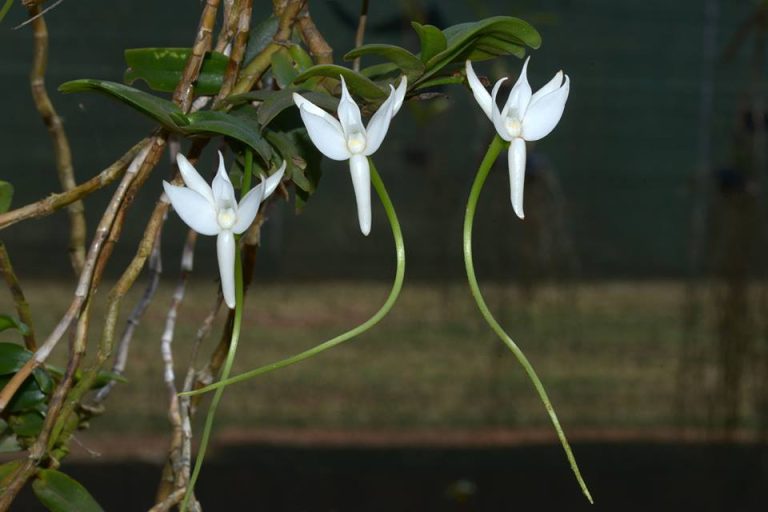
This orchid is a miniature to small epiphytic subshrub, typically reaching about 30 cm in overall height.[2] The stem is slender and may be slightly compressed. Leaves are linear, very thin, rigid, and arranged alternately in a whorl of three to six, each leaf being caniculate‑pleated and obtusely bilobed at the tip.[3] The inflorescence is axillary, 2–6 cm long, bearing 5–10 small flowers that are spaced along the axis and subtended by two to three sheaths.[3]
The flowers are diminutive, approximately 6 mm (0.2 in) across, with white to greenish‑white tepals and a fragrant scent noted in cultivation.[2][3] The lip is modest in size, and the nectar spur is relatively long, ranging from 2 to 6 cm, projecting from the back of the flower.[3] These combined characters—tiny white flowers, long spur, and very thin linear leaves—help separate A. caricifolium from other sympatric Angraecum species such as A. aloifolium (which has broader leaves) and A. ambrense (which bears larger flowers).
Native Range and Habitat
The species is endemic to Madagascar, occurring in the north‑eastern and central parts of the island’s wet tropical biome.[1] In the wild it grows as an epiphyte on tree trunks within moss‑rich forests, typically at elevations between 900 and 1 400 m.[3] The habitat is characterized by high humidity, frequent mist, and a constant supply of moisture, reflecting the moist montane forest conditions of the island’s interior.
Species‑Specific Care
| Factor | Documented guidance | Evidence |
|---|---|---|
| Growth medium / mounting | Mount on bark or tree‑branch equivalents; a well‑aerated medium that retains moisture mimics its epiphytic habit. | [1] |
| Watering | Provide regular watering; the plant has low drought tolerance and should never be allowed to dry out. | [2] |
| Humidity | Maintain high humidity (≥70 %). Native forest is moist; low humidity can cause leaf desiccation. | [1][2] |
| Light | Bright, filtered light similar to that under a forest canopy; direct midday sun should be avoided. | [1] |
| Temperature | Not documented for this species; growers should observe the elevation range (900–1400 m) and provide moderate temperatures. | Not documented |
| Fertilisation | Not documented. | Not documented |
| Seasonal rest | Not documented. | Not documented |
In practice, growers treat A. caricifolium as a moisture‑loving epiphyte: keep the roots moist, mist frequently, and ensure good air circulation to prevent fungal problems. Because the plant flowers throughout the year in its native range, a constant supply of moisture and light generally promotes regular blooming.
Flowering and Pollination
Flowering has been reported as occurring in all months of the year, indicating a near‑continuous blooming cycle in its natural environment.[2] Individual flowers are short‑lived, lasting only a few days, and emit a sweet fragrance, especially in the evening.[2][3] The long, tubular spur (2–6 cm) suggests adaptation to moth pollinators with long proboscises, a common pollination syndrome in Angraecum, but specific pollinator observations for this species have not been documented.Not documented
Conservation and Responsible Cultivation
An IUCN Red List entry exists for Angraecum caricifolium, but the publicly available snippet does not provide its threat category or assessment date.[4] Consequently, the formal conservation status is not documented here. Growers are encouraged to source plants from reputable, CITES‑compliant nurseries and to support habitat conservation initiatives in Madagascar.
Evidence and Limitations
Key information such as precise temperature preferences, fertilisation regimes, and documented pollinators is absent from the available sources. The care recommendations are derived from the species’ epiphytic habit, low drought tolerance, and high‑humidity forest habitat. Further field studies and horticultural trials would be valuable to refine cultivation protocols.
Frequently asked questions
What type of habitat does Angraecum caricifolium naturally grow in?
It is an epiphyte of moss‑rich, wet tropical forest in central and north‑eastern Madagascar, occurring on tree trunks at elevations of about 900–1 400 m.[1][3]
When does Angraecum caricifolium flower?
Flowering has been reported throughout the year, with individual blossoms lasting only a few days and emitting a sweet fragrance.[2][3]
How should I water Angraecum caricifolium in cultivation?
The species has low drought tolerance and should be kept regularly moist; allow the roots to stay damp but not waterlogged.[2]
FOLLOW THE EVIDENCE
Sources & references
- Angraecum caricifolium H.Perrier | Plants of the World Online | Kew Science, https://powo.science.kew.org/taxon/urn:lsid:ipni.org:names:616008-1
- Angraecum caricifolium (Angraecum caricifolium) | NativePlants.info, https://www.nativeplants.info/plant/magnoliophyta-flowering-plants/orchidaceae/angraecum/angraecum_caricifolium.html
- IOSPE PHOTOS – Angraecum caricifolium, https://www.orchidspecies.com/angcaricifolium.htm
- Angraecum caricifolium: IUCN Red List of Threatened Species, https://doi.org/10.2305/iucn.uk.2025-1.rlts.t69292060a69302705.en