At a glance
RECORDED PROFILE DATA- Scientific name
- Angraecum breve Schltr.
- Name status
- Accepted
- Native region
- Northern Madagascar (Mt. Tsaratanana)
- Growth habit
- Epiphytic miniature orchid
- Cultivation temperature group
- Cool
Names and Taxonomy
Angraecum breve Schltr. is the accepted name for this species according to Kew’s Plants of the World Online (POWO) [1]. The name was first published in Repert. Spec. Nov. Regni Veg. Beih. 33: 324 (1925) [1]. A later homotypic synonym is Perrierangraecum breve (Schltr.) Szlach., Mytnik & Grochocka, established in 2013 [1]. The epithet “breve” refers to the plant’s short stature, a meaning noted on IOSPE [2]. No other common names are documented beyond this descriptive meaning.
How to Identify This Species
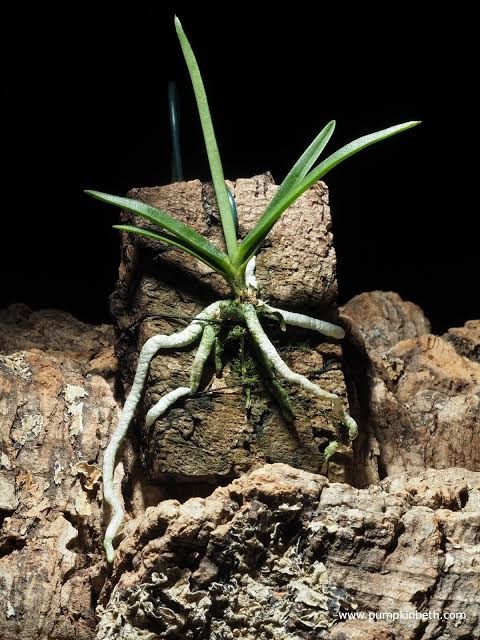
Angraecum breve is a very small, epiphytic orchid that forms a short, monopodial stem usually less than 10 cm long. The plant bears a few narrow, grey‑green, leathery, ligulate leaves that are unequal‑bilobed at the tip and overlap basally [2]. Roots are flattened, sometimes verrucose, and adhere to lichen‑covered bark.
The single flower is borne on an axillary inflorescence about 1 cm long, surrounded by two to three slightly flattened sheaths. The flower measures roughly 3.4 cm (1.4 in) across, is white with a faint green marking, and has a long, slender nectar spur that hangs well below the flower [2]. Fragrance is reported as pleasant and nocturnal, attracting moth pollinators in its native habitat [11].
Because of its miniature size and similar leaf shape, it can be confused with other tiny Angraecum species such as A. ambrense. However, the combination of a very short stem, flattened verrucose roots, and a distinctly long spur helps to separate it.
Native Range and Habitat
The species is endemic to northern Madagascar, specifically the Mt. Tsaratanana massif in the Tsaratanana Reserve [1][3]. It grows at elevations around 1,800 m in a wet tropical biome, typically as an epiphyte on lichen‑covered tree branches [2][11]. The habitat is cool and very humid, reflecting the high‑elevation montane forest conditions of the region.
Species‑Specific Care
| Factor | Documented guidance | Source |
|---|---|---|
| Growth medium | Well‑draining bark mix or mounted on cork/bark; avoid water‑logged media. | [5] |
| Light | Bright, filtered light similar to Phalaenopsis; avoid direct harsh sun. | [5] |
| Temperature | Cool to intermediate; night temperatures down to 10–12 °C, day temperatures 18–24 °C. | [5][11] |
| Humidity | High humidity (≥60 %); mist frequently or maintain a humid micro‑environment. | [5][11] |
| Watering | Keep medium evenly moist but never soggy; allow slight drying between waterings. | [5] |
| Fertiliser | Apply a dilute balanced orchid fertilizer (¼ strength) during active growth. | [5] |
| Airflow | Good air circulation to prevent rot and fungal issues. | [5] |
| Repotting / mounting | Repot or re‑mount when the bark medium breaks down, typically every 2–3 years. | [5] |
| Seasonal rest | Not documented for this species; growers may follow a mild reduction in watering during cooler months. | Not documented |
Overall, Angraecum breve thrives in conditions that mimic its cool, humid montane forest origin: bright, indirect light; a cool night; high humidity; and a well‑aerated, bark‑based substrate. Because the plant is very slow‑growing, it tolerates only modest changes in watering and should not be over‑fertilised.
Flowering and Pollination
In the wild, flowering occurs in the cooler months of the Malagasy winter, but precise phenology is not well documented. Cultivated specimens have been reported to flower throughout the year, likely reflecting the ability to induce blooms under stable indoor conditions [4]. Flowers are white, emit a pleasant fragrance at night, and possess a long spur that suggests pollination by hawk moths; however, direct pollinator observations for this species are lacking, and the moth hypothesis is inferred from spur morphology and the nocturnal scent [11]. Flower longevity is not specifically recorded.
Evidence and Limitations
Most morphological and habitat information comes from the IOSPE species page and horticultural observations (Pumpkin Beth, Begin With Plants). Formal ecological studies of Angraecum breve are limited, so details such as exact flowering season in the wild, pollinator identity, and long‑term conservation status remain uncertain. The care recommendations are based on grower reports rather than peer‑reviewed trials; growers should adjust practices based on plant response.
Frequently asked questions
How large does Angraecum breve grow?
In cultivation the plant typically reaches about 20–30 cm in overall height, with a short stem of less than 10 cm and a few narrow leaves [2][5].
When does Angraecum breve flower?
Cultivated plants have been reported to flower throughout the year, but precise natural flowering periods are not documented; growers often see blooms in the summer to fall months under indoor conditions [4].
FOLLOW THE EVIDENCE
Sources & references
- Angraecum breve Schltr. | Plants of the World Online | Kew Science (2026). https://powo.science.kew.org/taxon/urn:lsid:ipni.org:names:615988-1
- IOSPE PHOTOS – Angraecum breve (Schltr.) 1925. https://www.orchidspecies.com/angbreve.htm
- Angraecum breve – Pumpkin Beth. https://www.pumpkinbeth.com/plants/angraecum-breve/
- Angraecum breve | NativePlants.info. https://www.nativeplants.info/plant/magnoliophyta-flowering-plants/orchidaceae/angraecum/angraecum_breve.html
- Angraecum breve – Begin With Plants. https://beginwithplants.com/products/angraecum-breve

