At a glance
RECORDED PROFILE DATA- Scientific name
- Angraecum aloifolium Hermans & P.J.Cribb
- Name status
- Accepted in POWO; homotypic synonym Humblotiangraecum aloifolium
- Native region
- Northwestern Madagascar
- Growth habit
- Epiphytic subshrub
- Cultivation temperature group
- Not documented as a formal group; IOSPE describes it as hot growing
- Plant size
- One awarded specimen 10 cm wide x 6.5 cm tall; IOSPE calls it medium sized
- Flower size
- IOSPE 2 in (5 cm); AOS award natural spread 4.6 x 4.4 cm
- Habitat elevation
- 0–400 m in secondary sources
- Flowering context
- Late winter to early spring per IOSPE; April 2022 AOS award
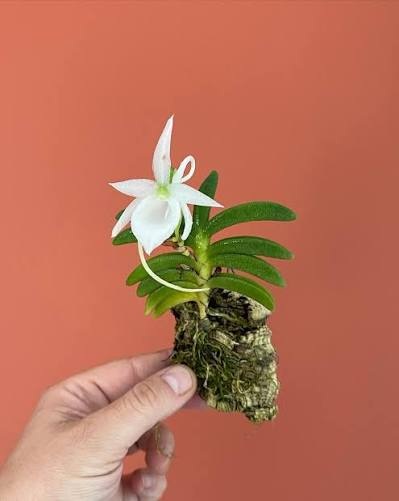
Angraecum aloifolium Hermans & P.J.Cribb is a compact epiphytic orchid from northwestern Madagascar. It is accepted in Kew’s Plants of the World Online, where it is recorded as an epiphytic subshrub in the seasonally dry tropical biome [1]. Horticultural sources describe it as compact, with thick, pitted, aloe-like leaves and white stellate flowers bearing a long, s-shaped spur [3][4][6]. A later segregate name exists, but POWO treats it as a homotypic synonym rather than a separate species [1][9].
Names and Taxonomy
The accepted scientific name is Angraecum aloifolium Hermans & P.J.Cribb. POWO records first publication in Orchid Review 105: 108 (1997) and accepts the species [1]. The same source treats Humblotiangraecum aloifolium (Hermans & P.J.Cribb) Szlach., Mytnik & Grochocka, published in Biodiversity Research and Conservation 29: 15 (2013), as a homotypic synonym [1][9]. The segregate combination should not be read as evidence of a separate species.
The common name The Aloe-Like Leafed Angraecum is given by IOSPE and repeated by a secondary care page [4][5]. IOSPE also places the species in Angraecum section Perrierangraecum [4]; that sectional placement was not checked against POWO in the available excerpts. Angraecum is a large genus of tropical African and Malagasy orchids, divided into sections in the horticultural literature [7].
How to Identify This Species
POWO describes A. aloifolium as an epiphytic subshrub [1]. IOSPE describes it as a medium-sized, hot-growing epiphyte with a stem carrying narrowly ensiform, thick, leathery, pitted leaves and an axillary, short, few-flowered inflorescence [4]. A grower page calls it a small species with thick, pitted, jewel-green leaves [6], while a commercial listing calls it miniature and compact [10]. These size words are relative and are not a substitute for measurements.
One AOS award record gives useful dimensions for a single cultivated plant: the plant was 10 cm wide by 6.5 cm tall, with 11 leaves; the largest leaf was 5.7 cm long, 1.0 cm wide, and 0.5 cm thick, dark green, conduplicate, with a finely pitted surface and a smooth margin. The roots were white with green growing tips, and the plant was mounted on a piece of wood 6 cm wide by 17 cm long [3]. These are observations of one awarded specimen, not a species-wide size range.
Flowers in that award record were white and stellate, with two flowers on one 1 cm inflorescence; the natural spread was 4.6 cm by 4.4 cm. The dorsal sepal measured 2.6 cm by 0.7 cm and the lateral sepals 2.5 cm by 0.5 cm. The lip was funnel-shaped proximally, and the spur was s-shaped, 7.5 cm long and 0.2 cm wide, white in the proximal half and pale chartreuse in the distal half. The ovary was flattened, chartreuse, 5.5 cm long and 0.4 cm wide [3]. IOSPE gives a flower size of 2 in (5 cm) [4], which is close to the award record’s spread but not identical; flower size should therefore be treated as variable or measurement-dependent. No fragrance data were found in the available sources.
Identification from a label or a single photograph is risky. The AOS record notes that the determination was confirmed using pitted leaf surfaces and lip size, and that the plant matched published descriptions and photographs [3]. Those are useful checks, but they do not make any one feature sufficient by itself. A confident identification should combine vegetative characters, flower structure, provenance, and comparison with a verified description or herbarium specimen.
Native Range and Habitat
POWO gives the native range as northwestern Madagascar and records the species in the seasonally dry tropical biome [1]. Secondary sources narrow the known area to Mahajanga Province in northwestern Madagascar and describe dry deciduous forest at low altitude, with an elevation range of 0–400 m in one account and about 400 m in another [5][6]. IOSPE likewise reports dry deciduous forests at low altitudes in northwestern Madagascar [4]. The precise extent of occurrence is not documented in the available excerpts.
The species is recorded as an epiphyte growing on tree branches [6][10]. POWO’s growth-habit term is epiphytic subshrub [1]. No host-tree specificity, population-size estimate, or microhabitat study was available. The habitat is described as seasonally dry, with a long dry period in secondary accounts [5][6]; that seasonality is habitat context, not a cultivation prescription by itself.
Species-Specific Care
Species-specific cultivation evidence is thin. The table separates direct species records from secondary grower recommendations and genus-level context. It does not give a complete greenhouse protocol.
| Factor | Documented guidance | Evidence or context |
|---|---|---|
| Temperature | No species-specific temperature range located. IOSPE describes the species as hot growing [4]. | The label hot growing is a horticultural descriptor, not a measured set of day and night temperatures. Genus-level guidance notes that Angraecum species range from lowland to montane habitats and should not all be grown alike [7][8]. |
| Light | Very bright but diffused light [6]. | A single grower recommendation. It is consistent with the dry, bright habitat description but is not an experimental light trial. |
| Watering | One secondary account describes a natural rest from November to March and, in cultivation, a shorter two-month winter rest with reduced watering: about once every two weeks if bare-root or once every four weeks if potted, plus light morning steaming of the stem every three to four days [5]. Another grower advises slightly reduced but constant regular watering in winter, especially for younger plants [6]. | These are horticultural opinions, not species-specific trials. They disagree on how dry winter should be; use them as cautionary context, not a rigid schedule. |
| Humidity and airflow | High humidity with good air circulation around the roots [6]; one account gives a humidity floor of 70% [5]. | The 70% figure is a grower target, not a documented habitat measurement. Airflow is emphasized because the plant is epiphytic. |
| Potting or mounting | An awarded specimen was mounted on wood [3]. A commercial listing calls the plant compact and suitable for a terrarium [10]. | Mounting is documented for one cultivated plant; terrarium suitability is a vendor description. No species-specific medium comparison was found. |
| Feeding | Not documented for this species. | Genus-level guidance suggests balanced fertilizer at half strength while actively growing [8], but that should not be presented as a verified A. aloifolium requirement. |
| Repotting | Not documented for this species. | Genus-level guidance says Angraecum plants dislike root disturbance and are often mounted or basket-grown [8]. Species-specific timing and medium are not documented. |
| Seasonal changes | A secondary account describes a prolonged dry rest in nature from November to March and reduced winter watering in cultivation [5]; another warns that older plants may tolerate a drier winter better than young plants [6]. | The rest period is not confirmed by a formal phenology study in the available sources. Do not impose a hard dry rest without monitoring plant condition. |
The safest reading of the care evidence is conservative. The plant is epiphytic and is documented on a mount, so root airflow and a well-aerated growing environment are practical priorities [3][6]. Bright, diffused light and moving air are repeated themes [6]. Where sources disagree about winter dryness, the disagreement is meaningful: one account describes a long natural dry season and reduced winter watering [5], while another cautions that young plants may not survive severe drying and recommends only slightly reduced but regular winter watering [6]. Treat the first as a description of seasonal tendency and the second as a risk warning, not as values to average.
No species-specific day/night temperature thresholds, fertilizer rates, potting mixes, or repotting intervals were found. The IOSPE phrase hot growing [4] and the genus-level warning that Angraecum care varies by altitude [7][8] should prevent a grower from applying a single warm-house formula to every species. Because the available care records come from cultivation, they describe cultivated plants, not measured habitat conditions.
Flowering and Pollination
IOSPE reports flowering in late winter and early spring on a short, axillary, few-flowered inflorescence [4]. The source does not specify whether those seasons refer to the northern or southern hemisphere. An AOS award record from Mid-America dated April 2022 documents two stellate flowers on one 1 cm inflorescence [3]. A secondary care account says the species flowers after a rest period and describes a natural rest from November to March [5]; that is a grower compilation, not a formal phenology study. Flower longevity, fragrance timing, and nectar volume were not documented in the available sources.
The long, s-shaped spur is documented in the award record [3], but no pollinator observation was supplied. The available evidence therefore supports the morphology of the spur, not a named pollinator. Any statement that a particular moth, bee, or bird pollinates A. aloifolium would require a separate source and is not made here.
Conservation and Responsible Cultivation
POWO lists the IUCN Red List category for A. aloifolium as DD, Data Deficient [2]. The excerpt does not give an assessment date, so the date should not be inferred. POWO also cites the Angiosperm Extinction Risk Predictions v1 (2024), which predicts the species to be threatened with a confidence rating of confident [2]. That is a modelled prediction, not a formal IUCN category, and it should be reported as such.
A horticultural page describes threats including illegal collection for the orchid trade, climate change, human expansion, forest clearing, logging, and slash-and-burn [6]. These are general concerns about the species and its habitat, not a legal determination. A nursery listing or commercial availability does not by itself demonstrate that a plant was lawfully collected or propagated; buyers should ask for provenance and permit information where required. No legal status or trade regulation was verified in the available sources.
Evidence and Limitations
This profile relies on POWO for accepted-name status and distribution [1], POWO general information for conservation listings [2], an AOS award record for one cultivated specimen’s measurements [3], IOSPE for a species description and flowering season [4], and secondary horticultural pages for care observations [5][6]. Genus-level context comes from AOS and Cape Orchid Society guides [7][8]. The original 1997 description, a full taxonomic revision, herbarium specimens, and pollinator studies were not available in the supplied evidence. Fragrance, flower longevity, pollination, host-tree specificity, population size, and species-specific temperature and fertilizer requirements are Not documented in the available sources. The care section should be read as a qualified summary of grower experience and genus context, not as a tested cultivation protocol.
Frequently asked questions
Is Angraecum aloifolium an accepted species?
Yes. POWO accepts Angraecum aloifolium Hermans & P.J.Cribb and treats Humblotiangraecum aloifolium as a homotypic synonym [1][9].
Where does Angraecum aloifolium come from?
POWO gives northwestern Madagascar; secondary sources place it in Mahajanga Province in dry deciduous forest at low elevation, with 0–400 m reported [1][5][6].
What temperature does Angraecum aloifolium need?
No species-specific temperature range was found. IOSPE describes it as hot growing [4], but genus-level guidance warns that Angraecum species vary by altitude and should not all receive the same conditions [7][8].
Does Angraecum aloifolium need a winter rest?
One secondary care account describes a November–March rest in nature and reduced winter watering in cultivation [5]; another cautions against severe drying, especially of young plants [6]. This is grower guidance, not an experimentally verified protocol.
What is the conservation status of Angraecum aloifolium?
POWO lists IUCN Red List status as DD (Data Deficient) [2]. A 2024 extinction-risk prediction cited by POWO predicts threatened, but that is a model, not a formal IUCN assessment [2].
Related terminology
- Humblotiangraecum
- A segregate genus name used for some orchids formerly placed in Angraecum; Humblotiangraecum aloifolium is a homotypic synonym of Angraecum aloifolium in POWO [9].
- Seasonally dry tropical biome
- A tropical biome with a pronounced dry season; POWO places Angraecum aloifolium in this biome [1].
- S-shaped spur
- The long, curved spur recorded for the awarded Angraecum aloifolium specimen [3].
FOLLOW THE EVIDENCE
Sources & references
- Angraecum aloifolium Hermans & P.J.Cribb | Plants of the World Online | Kew Science. Royal Botanic Gardens, Kew. https://powo.science.kew.org/taxon/urn:lsid:ipni.org:names:994107-1
- Angraecum aloifolium Hermans & P.J.Cribb | Plants of the World Online | Kew Science: general information. Royal Botanic Gardens, Kew. https://powo.science.kew.org/taxon/urn:lsid:ipni.org:names:994107-1/general-information
- AOS award record: Angraecum-aloifolium-M-&-B-HCC-79-Pts-2022-04-14. American Orchid Society, 2022. https://www.aos.org/awards-judging/sitf-findings/Angraecum-aloifolium-M-B-HCC-79-Pts-2022-04-14
- IOSPE PHOTOS: Angraecum aloifolium. Orchidspecies.com. http://www.orchidspecies.com/angaliofolium.htm
- Angraecum aloifolium care and culture. Travaldo's blog. https://travaldo.blogspot.com/2018/05/angraecum-aloifolium-care-and-culture.html
- Angraecum aloifolium. Pumpkin Beth. https://www.pumpkinbeth.com/plants/angraecum-aloifolium/
- Angraecum. American Orchid Society. https://www.aos.org/explore/angraecum
- Growers guides | Angraecum. Cape Orchid Society. http://www.capeorchidsociety.co.za/wp-content/uploads/2019/06/Angraecum.pdf
- Humblotiangraecum aloifolium (Hermans & P.J.Cribb) Szlach., Mytnik & Grochocka | Plants of the World Online | Kew Science. Royal Botanic Gardens, Kew. https://powo.science.kew.org/taxon/urn:lsid:ipni.org:names:77138653-1
- Angraecum aloifolium. Orchideeen-shop. https://orchideeen-shop.nl/en/products/angraecum-aloifolium

