At a glance
RECORDED PROFILE DATA- Scientific name
- Angraecum salazianum (Cordem.) Schltr.
- Name status
- Accepted
- Native region
- Réunion
- Growth habit
- Epiphytic subshrub
- Cultivation temperature group
- Not documented
Names and Taxonomy
The accepted scientific name is Angraecum salazianum (Cordem.) Schltr. It was first transferred to Angraecum in Beih. Bot. Centralbl. 33: 427 (1915)【1】. Kew’s Plants of the World Online lists the name as accepted and records the native range as Réunion.
Synonyms recorded by Kew include:
- Mystacidium salazianum Cordem. (original description, 1899)
- Lesliegraecum salazianum (Cordem.) Szlach., Mytnik & Grochocka (2013)
- Angraecum viridiflorum Cordem. (heterotypic synonym)
- Lesliegraecum viridiflorum (Cordem.) Szlach., Mytnik & Grochocka (2013)
No common name has been documented in the available sources.
How to Identify This Species
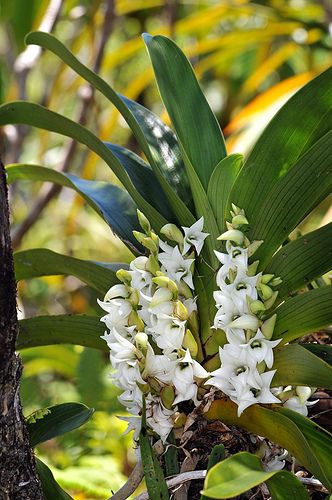
Angraecum salazianum is a miniature epiphytic subshrub. The stem is very short, about 1 cm tall, bearing leaves in two opposite rows. Individual leaves are roughly 2 cm long and 0.7 cm wide【3】. The plant produces an axillary inflorescence bearing two to three flowers.

The flowers are described as green in a French cultivation note【3】, whereas an online plant database records the bloom colour as white【2】. Both sources agree that the flowers are fragrant【2】. Detailed measurements of the flower parts (sepals, petals, spur) are not provided in the cited material.
Because the species is very small (overall plant height about 30 cm according to an online database【2】) and occurs in high‑altitude forest, it can be confused with the related endemic Angraecum cilaosianum. The key distinguishing feature noted for A. salazianum is the two‑row leaf arrangement on a minute stem and the limited number of flowers per inflorescence.
Native Range and Habitat
The species is endemic to the island of Réunion in the Mascarene archipelago【1】. It has been observed in the cirque of Salazie, a deep, moist valley at higher elevations, where it grows as an epiphyte on tree branches in the wet tropical biome【1】【3】. The habitat is characterised by high humidity and frequent cloud cover; specific elevation limits are not documented in the sources.
Species‑Specific Care
| Factor | Documented guidance | Evidence / Context |
|---|---|---|
| Temperature | Not documented | No species‑specific temperature range reported. |
| Light | Not documented | Habitat is a shaded, humid forest; precise light requirements not published. |
| Watering | Not documented | Native environment is consistently wet, but watering schedule for cultivation is not described. |
| Humidity | Not documented | High‑humidity forest home suggests a preference for moist air, yet quantitative targets are absent. |
| Mounting / Potting | Not documented | Only noted as an epiphyte; no cultivation protocol provided. |
| Feeding | Not documented | Fertilisation recommendations not found. |
| Seasonal changes | Not documented | Flowering reports differ (February vs. year‑round), indicating possible seasonal cues, but no care guidance. |
Because specific horticultural data are lacking, growers should treat A. salazianum as a typical high‑altitude Mascarene epiphyte: provide bright, indirect light, maintain constant high humidity, and keep temperatures similar to cool‑mountain forest conditions (≈15‑22 °C). These suggestions are extrapolated from the natural habitat and are not documented for this species.
Flowering and Pollination
One source records flowering in February in the cirque of Salazie【3】, while another database lists the species as blooming throughout the year【2】. The flowers are fragrant, a trait that often indicates moth pollination in Angraecum, but no pollinator has been observed or documented for this species.
Evidence and Limitations
The profile relies on a limited set of online references. Key horticultural parameters (temperature range, light intensity, watering regime) are not documented for Angraecum salazianum. Flower colour is reported as both green and white, reflecting a discrepancy between sources that cannot be resolved without further field observation or herbarium study. Pollination biology and conservation status are also undocumented.
Frequently asked questions
Is Angraecum salazianum commonly cultivated?
Information on cultivation is scarce; no specific growing guidelines have been published, suggesting it is not widely in cultivation.
What is the typical flower colour of Angraecum salazianum?
Sources differ: one description notes green flowers, while another records white blooms. The exact colour may vary or be undocumented.
FOLLOW THE EVIDENCE
Sources & references
- Angraecum salazianum (Cordem.) Schltr. | Plants of the World Online | Kew Science, https://powo.science.kew.org/taxon/urn:lsid:ipni.org:names:616393-1
- Angraecum salazianum (Angraecum salazianum) | NativePlants.info, https://www.nativeplants.info/plant/magnoliophyta-flowering-plants/orchidaceae/angraecum/angraecum_salazianum.html
- Angraecum salazianum - Orchidées, Artisteries, et autres bobineries, https://colombobine.over-blog.com/pages/Angraecum_salazianum-1219141.html