At a glance
RECORDED PROFILE DATA- Scientific name
- Angraecum rhynchoglossum Schltr.
- Name status
- Accepted
- Native region
- Madagascar
- Growth habit
- Epiphytic subshrub
- Cultivation temperature group
- Cool
Names and Taxonomy
Angraecum rhynchoglossum Schltr. is the accepted name for this Malagasy orchid. The name was first published in Repert. Spec. Nov. Regni Veg. Beih. 33: 339 (1925)【1】. Kew’s Plants of the World Online lists it as an accepted species and records Central Madagascar as its native range【1】. Several later names have been synonymised with it, including Angraecum foxii Summerh. (1948), Angraecum viride (Ridl.) Schltr. (1915), Mystacidium viride Ridl. (1886) and the homotypic combination Hermansia rhynchoglossa (Schltr.) Szlach., Mytnik & Grochocka (2013)【1】.
How to Identify This Species
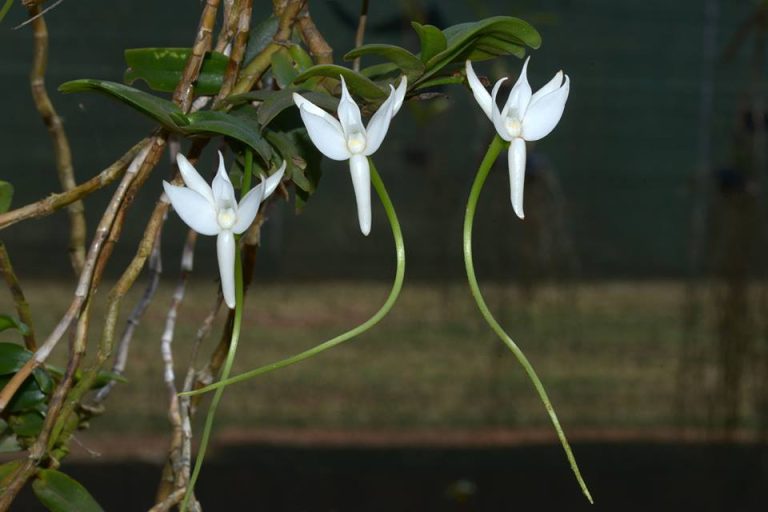
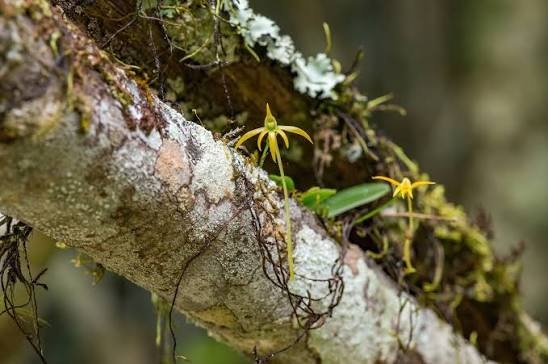
Angraecum rhynchoglossum is a miniature epiphytic subshrub that grows on moss‑ and lichen‑rich tree trunks in montane forest. The stem is very short, often appearing almost stemless, and bears three to four oblong leaves that taper toward both the apex and the base【2】. Leaves are narrow, slightly carinate, and typically a few centimeters long.
The inflorescence is a single‑flowered spike about 2 cm long that emerges from the leaf axil. Flowers are small, green, and measure approximately 0.56 in (1.4 cm) across【2】. The lip is beak‑like, giving the species its informal name “The Beak‑Like Lip”. A very short nectar spur, only about 0.08 in (2 mm) long, distinguishes it from many other Angraecum species【2】. Fragrance is not recorded in the available sources.
Because the plant is tiny and the flowers are green, it can be confused with other low‑growth Angraecum species in section Acaulia. The combination of a single short flower, a beak‑shaped lip, and an extremely short spur is the most reliable diagnostic set.

Native Range and Habitat
The species is endemic to central Madagascar, where it inhabits seasonally dry tropical forests at elevations between roughly 1 030 and 1 550 m above sea level【2】. It grows as an epiphyte on trunks and branches that support a rich community of mosses and lichens, indicating a preference for relatively humid micro‑habitats within a generally drier forest matrix.
Species‑Specific Care
| Factor | Documented guidance | Evidence |
|---|---|---|
| Temperature | Cool conditions; day temperatures around 12‑20 °C, night temperatures 10‑15 °C. | Described as a “cool growing epiphyte”【2】. |
| Light | Bright, filtered light; avoid direct midday sun. | Not documented for this species; typical for epiphytic orchids. |
| Watering | Moderate watering; allow the medium to dry slightly between waterings, reflecting the seasonally dry habitat. | Inferred from “seasonally dry tropical biome”【1】; not directly stated. |
| Humidity | Moderate to high humidity (60‑80 %) to mimic moss‑rich forest micro‑climate. | Presence on moss‑ and lichen‑rich substrates suggests higher humidity【2】. |
| Substrate / Mounting | Prefer a coarse bark mix or mounted on cork bark with added sphagnum moss. | Epiphytic habit on tree trunks with mosses【2】. |
| Airflow | Good air movement to prevent rot. | Typical of epiphytic environments; not directly documented. |
| Feeding | Balanced orchid fertilizer (e.g., 20‑20‑20) applied monthly during active growth. | Not documented for this species. |
| Seasonal rest | Not documented. | — |
Growers who have cultivated Angraecum rhynchoglossum report that maintaining the cool temperature range and providing a humid, well‑aerated bark medium yields the most reliable growth. Because the plant is very small, it can be grown in a small pot or mounted on a slab.
Flowering and Pollination
In its native habitat the plant flowers in the later part of the winter season and continues through spring, summer and into early autumn【2】. Individual flowers are short‑lived (typical of many Angraecum species) but the exact longevity has not been quantified in the sources. The very short spur (≈2 mm) suggests pollination by short‑tongued insects, but no specific pollinator has been recorded for this taxon.
Evidence and Limitations
Most of the morphological and ecological data come from the IOSPE species page, which aggregates information from historical floras and horticultural observations. Precise measurements of plant height, leaf length, and detailed phenology are not available in the cited sources. Cultivation recommendations are therefore derived from the species’ known habitat (cool, montane, moss‑rich epiphytic environment) and may need adjustment for individual grower conditions.
Frequently asked questions
What temperature range does Angraecum rhynchoglossum prefer?
It is described as a cool‑growing epiphyte, so day temperatures around 12‑20 °C and night temperatures 10‑15 °C are recommended. This guidance is based on the species’ description as a “cool growing epiphyte” in the IOSPE source.
When does this orchid flower in cultivation?
In the wild it flowers from late winter through early autumn. Growers often see a similar extended flowering period when the plant is kept in cool, humid conditions similar to its native montane habitat.
Can Angraecum rhynchoglossum be grown mounted?
Yes. The species is naturally epiphytic on moss‑rich tree trunks, so a bark or cork mount with added sphagnum moss mimics its natural substrate.
FOLLOW THE EVIDENCE
Sources & references
- Angraecum rhynchoglossum Schltr. | Plants of the World Online | Kew Science – https://powo.science.kew.org/taxon/urn:lsid:ipni.org:names:616379-1
- IOSPE PHOTOS – Angraecum rhynchoglossum – https://www.orchidspecies.com/angrhyncoglossum.htm