At a glance
RECORDED PROFILE DATA- Scientific name
- Angraecum pterophyllum H.Perrier
- Name status
- Accepted (Kew POWO)
- Native region
- Madagascar
- Growth habit
- Epiphytic subshrub, seasonally dry tropical biome
- Cultivation temperature group
- Not documented
Names and Taxonomy
The accepted scientific name for this species is Angraecum pterophyllum H.Perrier, first described in 1938 in Notulae Systematicae (Paris) 7:106.[2] The name is listed as accepted by Kew’s Plants of the World Online.[1] A later nomenclatural combination places the species in the genus Pectinariella as Pectinariella pterophylla (H.Perrier) Verlynde & Ramand. (2016), which is recorded as a synonym in POWO and IOSPE.[1][3] No vernacular (common) name is documented in the available sources.
How to Identify This Species
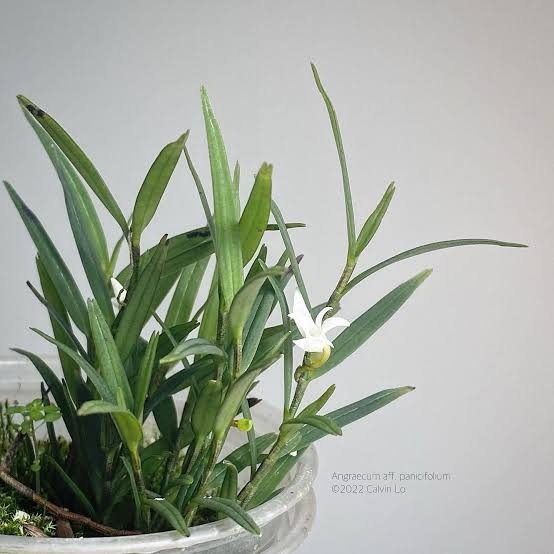
Growth habit. A miniature epiphytic subshrub that grows on tree branches in moss‑rich forests. Stems are erect, slender and 10–15 cm long, sometimes reported up to 30 cm in cultivation.[2][6]
Leaves. The plant bears up to ten distichous leaves that are linear, 35–38 mm long and 1.3–2.2 mm wide, with undulate‑pleated, recurved margins that form a conspicuous wing‑like extension along the leaf edge.[2][3]
Inflorescence. Typically a single flower borne on a short (≈1.5 mm) axillary peduncle, partially sheathed by three loose, apiculate bracts.[3]
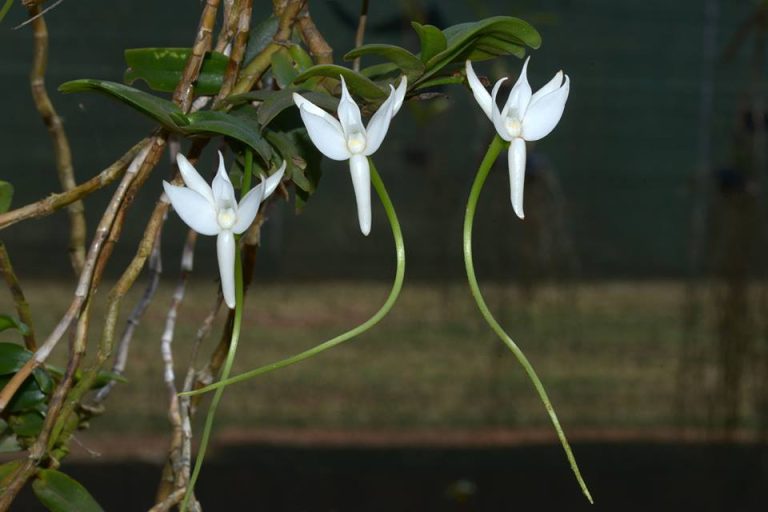
Flower. The flower is very small, about 4 mm across, white to greenish‑white, fragrant, and possesses a nectar spur of typical Angraecum length (exact measurement not documented). It is reported as single‑flowered in the original description.[3][2]
Diagnostic feature. The combination of winged, narrow leaves and a solitary minute white flower distinguishes it from other Madagascan Angraecum species, although careful comparison with closely related taxa such as A. panicifolium is advisable.[2]
Native Range and Habitat
Angraecum pterophyllum is endemic to Madagascar, reported from the east‑central and eastern parts of the island.[1][3] In the wild it grows as an epiphyte on tree branches within moss‑laden humid forests at elevations of roughly 960–1 200 m above sea level.[3] The species is associated with a seasonally dry tropical biome, indicating a preference for environments that experience a marked dry season yet retain sufficient moisture in the canopy.[1]
Species‑Specific Care
| Factor | Documented guidance | Source |
|---|---|---|
| Growth habit | Epiphytic; suitable for mounting on bark or grown in a very coarse, well‑draining medium. | [1][3] |
| Light | Not documented in the available sources. | |
| Temperature | Not documented in the available sources. | |
| Humidity | Not documented; native forest is humid. | |
| Watering | Low drought tolerance – requires regular moisture to avoid stress. | [4] |
| Fertiliser | Not documented. | |
| Seasonal rest | Not documented. |
Because the species is a small, moisture‑sensitive epiphyte, growers typically keep the plant mounted on a piece of bark or in a basket with coarse orchid mix, ensuring good airflow and frequent misting to mimic its forest canopy environment. Over‑dry conditions should be avoided, as the plant is reported to have low drought tolerance.[4] No reliable data were found concerning optimal temperature ranges, light intensity, or fertilisation regimes specific to this species.
Flowering and Pollination
In cultivation the plant has been observed to flower during the local summer and early autumn months (approximately November to February in Madagascar’s southern‑hemisphere summer).[3] Flowers are very small (≈4 mm diameter) and emit a noticeable fragrance, suggesting attraction of nocturnal pollinators, but no pollinator has been documented for this species.[3][6]
Evidence and Limitations
The profile is based on a limited number of primary sources: the original taxonomic description (1938), Kew’s taxonomic database, and a few horticultural entries. Detailed data on temperature preferences, light requirements, specific fertilisation, and natural pollinators are absent from the cited material. Consequently, many cultivation recommendations are extrapolated from the species’ epiphytic habit and the general ecology of its native forest, and should be treated as provisional.
FOLLOW THE EVIDENCE
Sources & references
- Angraecum pterophyllum H.Perrier | Plants of the World Online | Kew Science, https://powo.science.kew.org/taxon/urn:lsid:ipni.org:names:616355-1
- Sarcanthae nouvelles ou peu connues de Madagascar (fin), Notulae Systematicae 7(3):105‑139 (1938), https://biodiversitylibrary.org/part/324457
- IOSPE PHOTOS – Angraecum pterophyllum, http://www.orchidspecies.com/angpterophyllum.htm
- Angraecum pterophyllum – NativePlants.info, https://www.nativeplants.info/plant/magnoliophyta-flowering-plants/orchidaceae/angraecum/angraecum_pterophyllum.html
- Angraecum pterophyllum – orchidroots, https://orchidroots.com/display/summary/orchidaceae/9626/