At a glance
RECORDED PROFILE DATA- Scientific name
- Angraecum perparvulum H.Perrier
- Name status
- Accepted
- Native region
- Madagascar
- Growth habit
- Epiphytic subshrub (epiphyte)
- Cultivation temperature group
- Not documented
Names and Taxonomy
The accepted name for this species is Angraecum perparvulum H.Perrier. It was first described in Notulae Systematicae (Paris) 7:123 (1938) and is listed as an accepted name by Kew’s Plants of the World Online [1]. A later homotypic synonym is Lesliegraecum perparvulum (H.Perrier) Szlach., Mytnik & Grochocka [1]. No common name has been recorded in the consulted sources.
How to Identify This Species
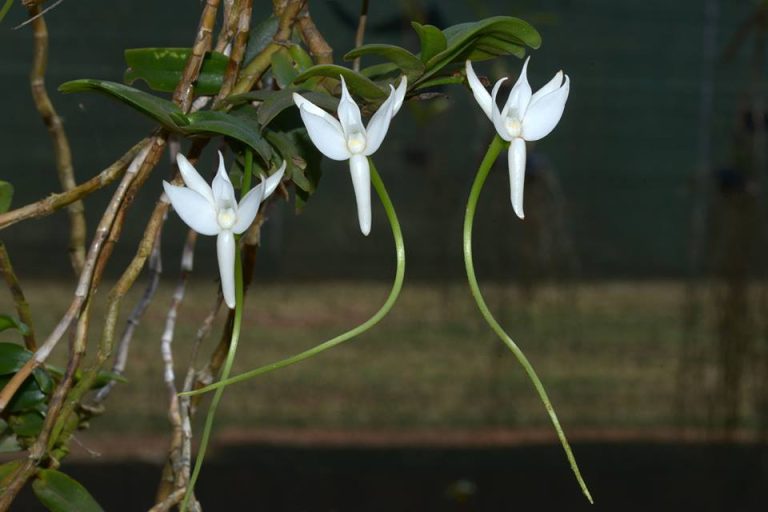
In the field the plant is a very small epiphytic subshrub, usually no taller than 10 cm [2]. It bears a short stem with a few narrow, carinate leaves. The inflorescence carries one or a few white flowers that are fragrant; bloom time is reported throughout the year [2]. Detailed measurements of flower parts, spur length, or leaf dimensions are not provided in the available literature.
Native Range and Habitat
Angraecum perparvulum is native to the northern and central regions of Madagascar, occurring in wet tropical forest where it grows as an epiphyte on tree trunks and branches [1]. Some orchid checklists also record the species from the Mascarene Islands, but the primary, peer‑reviewed source (POWO) restricts its native range to Madagascar, and this discrepancy is noted for future verification [3]. The species is associated with the evergreen, humid forest biome and is typically found at low to mid elevations, although precise altitude limits are not documented.
Species‑Specific Care
| Factor | Documented Guidance | Source |
|---|---|---|
| Moisture | Requires consistently moist conditions; low drought tolerance indicates it should not be allowed to dry out. | [2] |
| Light | Not documented. | |
| Temperature | Not documented. | |
| Humidity | Not documented. | |
| Substrate / Mounting | Being an epiphyte, it is normally grown on bark slabs, cork, or in a very coarse, well‑draining medium that mimics tree bark. | Inference based on habit; no specific source. |
| Fertilisation | Not documented. | |
| Seasonal Rest | Not documented. |
Because the species is diminutive and highly moisture‑sensitive, growers should aim to keep the growing medium evenly moist but not water‑logged, and provide good air circulation to prevent rot. Light and temperature requirements remain uncertain and should be matched to the conditions of Madagascar’s humid lowland forests – moderate shade and warm, stable temperatures – until species‑specific data become available.
Flowering and Pollination
Flowers are reported to be white, fragrant, and capable of blooming in any month of the year, suggesting a non‑seasonal flowering pattern [2]. No data on flower size, spur length, or pollinator identity have been found for this species, so pollination mechanisms remain undocumented.
Evidence and Limitations
The profile relies on three main sources: Kew’s Plants of the World Online for taxonomy and native range, NativePlants.info for growth habit and basic cultural notes, and a general orchid compendium that mentions an alternate distribution record. Key aspects such as precise morphological measurements, detailed habitat elevation, light and temperature preferences, and pollination biology are not documented in the available literature and should be investigated further.
FOLLOW THE EVIDENCE
Sources & references
- Angraecum perparvulum H.Perrier | Plants of the World Online | Kew Science, https://powo.science.kew.org/taxon/urn:lsid:ipni.org:names:616332-1
- Angraecum perparvulum (Angraecum perparvulum) | NativePlants.info, https://www.nativeplants.info/plant/magnoliophyta-flowering-plants/orchidaceae/angraecum/angraecum_perparvulum.html
- Angraecum species list – Orchid Compendium, http://www.clanorchids.com/compendium/page3a.html