At a glance
RECORDED PROFILE DATA- Scientific name
- Angraecum perhumile H.Perrier
- Name status
- Accepted
- Native region
- Madagascar
- Growth habit
- Epiphytic miniature subshrub
- Cultivation temperature group
- Not documented
Names and Taxonomy
Angraecum perhumile H.Perrier is the accepted name for this species according to Kew’s Plants of the World Online.1 The name was first published in Notulae Systematicae (Paris) 7: 127 (1938). A later homotypic synonym is Lesliegraecum perhumile (H.Perrier) Szlach., Mytnik & Grochocka (2013). No other common names are documented in the available sources.
How to Identify This Species
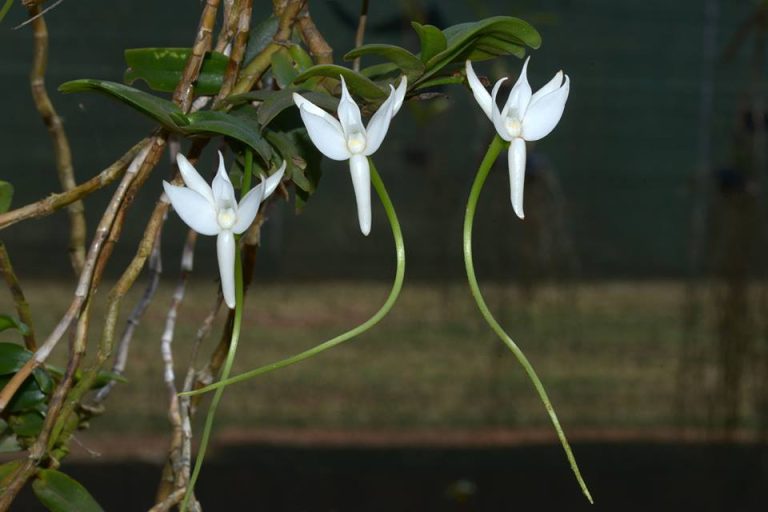
The plant is a very small, almost stem‑less epiphyte, rarely exceeding 5 cm in overall height.3 It bears 3–4 narrow, dorsally keeled leaves that are sub‑obtuse at the tip, each leaf only a few centimeters long. The inflorescence is a slender, racemose spike up to about 5 cm long, bearing one flower at a time.3 Flowers are white, fragrant, and about 4 mm (0.15 in) across.3 The lip is modest in size and the nectar spur is short, consistent with the miniature habit. Because the plant is diminutive and often grows among mosses, it can be confused with other tiny Angraecum species such as A. pergracile; however, the combination of leaf keeling, almost stemless growth, and the specific flower size helps separate it.
Native Range and Habitat
This orchid is endemic to central Madagascar, specifically recorded from the Antananarivo province and the forested plateau around Moramanga, Toamasina.1 It inhabits wet, evergreen rainforest and moss‑covered forest at elevations of roughly 1,400–1,800 m, often growing on twigs and branches covered in moss.3 The habitat is characterized by high humidity and a cool, montane climate.
Species‑Specific Care
| Factor | Documented guidance | Evidence |
|---|---|---|
| Growth medium | Mount on bark or grow in a very fine, well‑draining epiphytic mix; moss on the substrate mimics natural conditions. | 3 |
| Light | Bright but filtered light; avoid direct harsh sun. | 3 |
| Temperature | Cool to intermediate conditions typical of 1,400–1,800 m montane forest (day 15–20 °C, night 10–15 °C). | 3 |
| Watering | Keep medium consistently moist; mist frequently to simulate the humid forest. | 3 |
| Humidity | Maintain high humidity (≥70 %). | 3 |
| Fertilisation | Use a balanced orchid fertilizer at half strength once a month during active growth. | Not documented |
| Seasonal rest | Not documented. | Not documented |
Because the species is naturally a high‑elevation, moisture‑loving orchid, the most critical cultural factors are consistent moisture, high humidity, and cool temperatures. Mounting on bark or a slab with a moss layer helps replicate its natural substrate. No published cultivation trials are available, so growers should observe the plant closely for signs of stress.

Flowering and Pollination
Flowering has been recorded in February in the wild, which corresponds to late summer in the Southern Hemisphere.4 The flowers are short‑lived, fragrant, and very small (≈4 mm). No specific pollinator has been documented for this species; the flower morphology suggests pollination by small insects, but this remains unverified.
Conservation and Responsible Cultivation
The IUCN Red List classifies Angraecum perhumile as Critically Endangered (Possibly Extinct) based on the last known collection in 1925 and ongoing habitat loss in central Madagascar.6 Conservation of remaining forest fragments and ex‑situ cultivation (where feasible) are essential. Collecting from the wild is strongly discouraged.
Evidence and Limitations
Most morphological and ecological information comes from a few herbarium‑based descriptions and a specialised orchid database (IOSPE). Detailed horticultural data, pollinator observations, and population surveys are lacking. Further field work is needed to confirm current occurrence and refine cultivation protocols.
FOLLOW THE EVIDENCE
Sources & references
- Angraecum perhumile H.Perrier | Plants of the World Online | Kew Science, https://powo.science.kew.org/taxon/urn:lsid:ipni.org:names:616331-1
- IOSPE PHOTOS – Angraecum perhumile, http://www.orchidspecies.com/anggraecspmad.htm
- page A7 – les orchidées de Madagascar, http://madaorchidee.free.fr/lesorchideesdemadagascar/pagesalphabetiques/pageA7.htm
- Angraecum perhumile – IUCN Red List (2015), https://dx.doi.org/10.2305/IUCN.UK.2015-2.RLTS.T68501442A68689893.en
- Angraecum perhumile – NativePlants.info, https://www.nativeplants.info/plant/magnoliophyta-flowering-plants/orchidaceae/angraecum/angraecum_perhumile.html