At a glance
RECORDED PROFILE DATA- Scientific name
- Angraecum obesum H.Perrier
- Name status
- Accepted (Kew POWO)
- Native region
- Madagascar (central)
- Growth habit
- Epiphytic subshrub, occasionally lithophytic
- Cultivation temperature group
- Intermediate (13–27 °C)
How to Identify This Species
Angraecum obesum is a medium‑sized epiphytic orchid. The stem is short, ending in a densely leafy apical portion; leaves are thin, light‑green, bilobed and strongly veined【2】. The plant typically reaches about 25 cm in height in the wild, though cultivated specimens may vary.
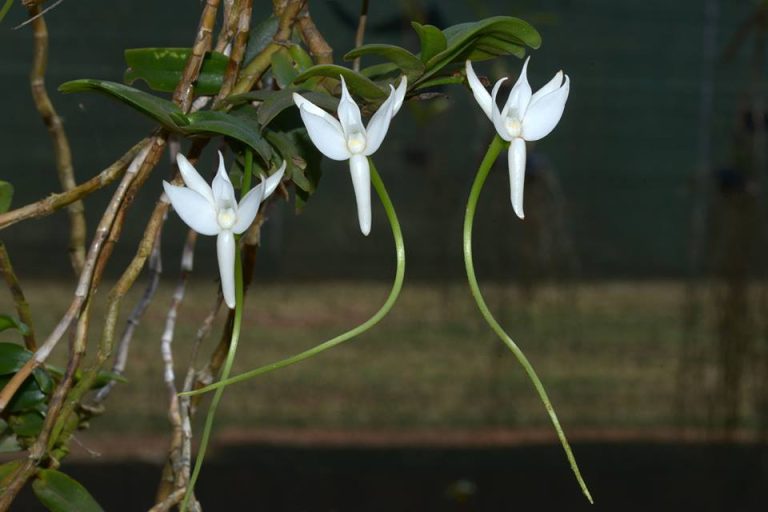
The single flower is borne on a very short inflorescence (2–3 cm long)【2】. Flowers measure 4.5 cm across according to IOSPE, with some growers reporting up to 5 cm【2】【3】. The perianth is white to greenish‑white, and the lip is bilobed. A notable feature is the long nectar spur, approximately 2.75 in (7 cm) in length【3】. The fragrance is described as faintly sweet, but detailed scent notes are not documented.
Because many Angraecum species share a single‑flower habit, reliable identification should combine leaf morphology, spur length, and the specific elevation and substrate of the collection site. Misidentifications are common when only a photograph of the flower is available.
Native Range and Habitat
The species is endemic to central Madagascar, occurring in the wet tropical biome of the island’s eastern slope【1】. It grows primarily in moss‑rich forests at elevations between 1000 and 1500 m (approximately 4000–5000 ft)【2】【3】. In the wild it is found on lichen‑covered tree trunks and occasionally among rocks, indicating a preference for humid, shaded micro‑habitats with good air circulation【2】【3】.

Species‑Specific Care
| Factor | Documented guidance | Source |
|---|---|---|
| Temperature | Intermediate range 13–27 °C (56–80 °F) | [3][4] |
| Light | Low to medium light; bright indirect preferred | [4] |
| Watering | Weekly watering with frequent misting; reduce to fortnightly in winter | [4] |
| Humidity | Not documented; plants originate from humid moss forests | Not documented |
| Mounting / Potting | Can be mounted on cork or tree‑slab; in pots use a coarse bark mix with chopped sphagnum moss | [4] |
| Fertilisation | Not documented in the sources | Not documented |
| Repotting | Not documented | Not documented |
| Seasonal care | Reduce watering in winter; maintain intermediate temperatures year‑round | [4] |
In practice, growers report successful cultivation mounted on cork or in a well‑draining bark‑sphagnum medium, with good air flow and regular misting to mimic the natural moss‑forest environment【4】. The species tolerates a moderate temperature swing but should not be exposed to prolonged cold (27 °C). Because the plant is a cool‑growing epiphyte, direct midday sun should be avoided.
Flowering and Pollination
Flowering occurs in late spring to early summer in the native range, roughly November to January in the Southern Hemisphere【2】. Each plant produces a single flower per inflorescence, and the flower persists for several weeks, though exact longevity is not recorded. The long nectar spur suggests adaptation to hawkmoth pollination, a pattern common in many Angraecum species, but no direct observation of pollinators for A. obesum has been published.
Conservation and Responsible Cultivation
An IUCN Red List entry exists for the species (IUCN SSC Madagascar Plant Specialist Group, 2015), but the assessment category is not provided in the available excerpt【5】. Consequently, the formal conservation status is Not documented here. Given its restricted range in central Madagascar’s forest fragments, growers are encouraged to obtain material from reputable, legally compliant sources and to support in‑situ conservation efforts where possible.
Evidence and Limitations
The profile draws on taxonomic data from Kew’s Plants of the World Online, horticultural observations from IOSPE and two grower‑focused websites, and a CITES‑related identification guide. Key gaps include precise leaf measurements, humidity requirements, fertilisation regime, and an official IUCN threat category. Further field studies would be valuable to clarify pollinator relationships and population status.
Frequently asked questions
What temperature range does Angraecum obesum prefer?
Growers report successful growth at intermediate temperatures of 13–27 °C (56–80 °F) in both mounted and potted situations【3】【4】.
Can Angraecum obesum be grown in a pot?
Yes. It can be potted in a coarse bark mix with chopped sphagnum moss, or mounted on cork or a slab for a more natural epiphytic setup【4】.
When does this species flower?
In its native habitat flowering occurs in late spring to early summer (approximately November–January in the Southern Hemisphere)【2】.
Is Angraecum obesum threatened?
An IUCN Red List entry exists, but the assessment category is not provided in the available source, so the formal threat status is not documented here【5】.
FOLLOW THE EVIDENCE
Sources & references
- Angraecum obesum H.Perrier, Plants of the World Online, Royal Botanic Gardens, Kew, 2026, https://powo.science.kew.org/taxon/urn:lsid:ipni.org:names:616300-1
- Angraecum obesum, IOSPE Orchid Species, 2026, https://www.orchidspecies.com/angobesum.htm
- Angraecum obesum cultivation notes, Marni Turkel, 2003, http://sonic.net/~mturkel/mostlyspecies/f.ang.obesum.html
- Angraecum obesum culture blog, Angraecoid Orchids, 2016, http://angraecoid-orchids.blogspot.com/2016/02/angraecum-obesum-h-perr-1938.html
- Angraecum obesum IUCN Red List entry, IUCN SSC Madagascar Plant Specialist Group, 2015, https://doi.org/10.2305/iucn.uk.2015-2.rlts.t69291985a69292606.en