At a glance
RECORDED PROFILE DATA- Scientific name
- Angraecum longicalcar (Bosser) Senghas
- Name status
- Accepted (Kew POWO)
- Native region
- Madagascar
- Growth habit
- Lithophytic subshrub
- Cultivation temperature group
- Not documented
Names and Taxonomy
Angraecum longicalcar (Bosser) Senghas is the accepted scientific name for this species according to Kew’s Plants of the World Online [1]. It was first described in 1986 in Orchideen Beschreib. Kult. Zücht. 3:1004 [2]. The only homotypic synonym is Angraecum eburneum var. longicalcar Bosser (1965) [2]. Common names include “long spurred Angraecum” and the French “Angraecum à long éperon” [5].
How to Identify This Species
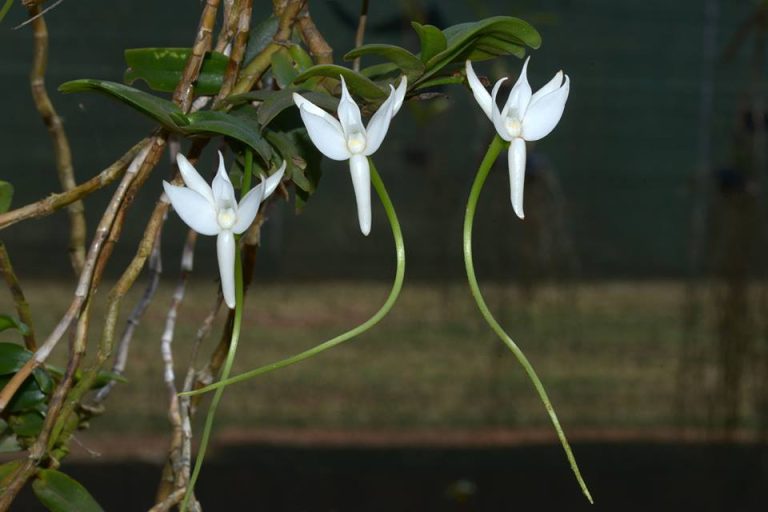
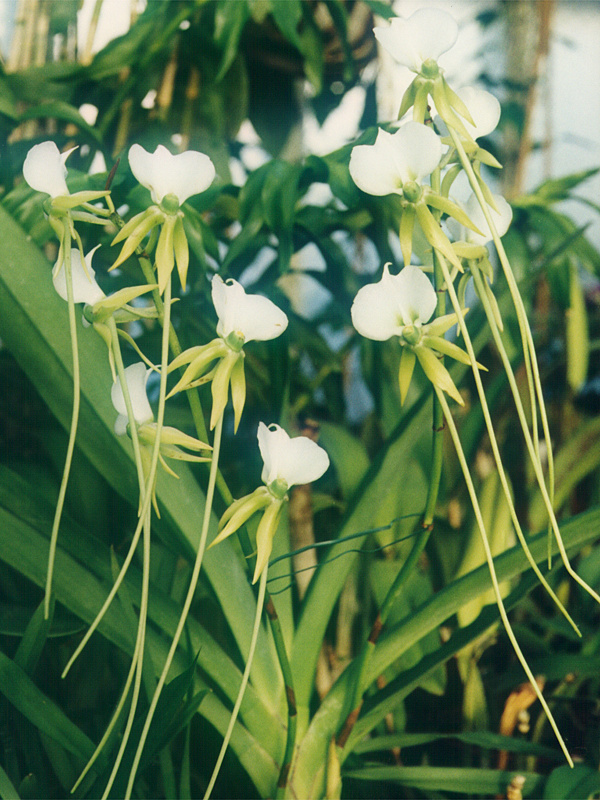
This orchid is a lithophytic subshrub that grows on exposed marble or limestone outcrops. Mature plants may reach 60–80 cm in height, with a single unbranched flowering stem (inflorescence) up to about 85 cm long [3]. Leaves are leathery, narrow‑elliptic and arranged alternately along the stem. The inflorescence bears roughly 10–12 white‑green flowers, each about 3 cm across [3]. The most diagnostic feature is the exceptionally long nectar spur, measuring up to 40 cm—far longer than the 8 cm spur of the closely related A. eburneum [3][5]. Flowers are strongly scented at night, a trait typical of moth‑pollinated Angraecum species [3]. Because the plant is lithophytic, it may be found growing directly on rock surfaces, sometimes with roots partially exposed.
Native Range and Habitat
Angraecum longicalcar is endemic to the central highlands of Madagascar, specifically the Itasy, Tsiroanomandidy and Ambatofinandrahana regions [4]. It occurs at elevations of roughly 1 000–1 200 m, on marble or other calcareous rock outcrops within a seasonally dry tropical biome [4][6]. The species is lithophytic, anchoring its roots in fissures of the rock and tolerating full sun to partial shade, depending on the exposure of the outcrop.
Species‑Specific Care
| Factor | Documented Guidance | Evidence |
|---|---|---|
| Substrate | Use a well‑draining, rock‑based medium (e.g., coarse bark mix or slabs of marble) to mimic natural limestone outcrops. | [4][5] |
| Watering | Allow the medium to dry for 2–3 days between waterings; avoid prolonged dryness that causes leaf wilting. | [5] |
| Humidity | Maintain moderate humidity; do not let the plant become excessively dry. | [5] |
| Light | Not documented – plants in the wild grow on exposed rock, but specific light requirements in cultivation have not been published. | Not documented |
| Temperature | Not documented. | Not documented |
| Airflow | Not documented. | Not documented |
| Fertilization | Not documented. | Not documented |
| Repotting / Re‑mounting | Not documented. | Not documented |
| Seasonal changes | Not documented. | Not documented |
In practice, growers who have successfully cultivated the species report using in‑vitro propagated plantlets and mounting them on rock slabs or in very coarse bark mixes. The key is to prevent waterlogging while providing enough moisture to keep the roots hydrated between watering cycles [5]. Because the plant originates from a seasonally dry environment, it tolerates short dry periods but should not be allowed to desiccate completely.
Flowering and Pollination
Flowering occurs in the rainy season, although exact months have not been recorded in the available sources [3]. Each inflorescence can bear up to 11 flowers that open sequentially. The flowers emit a strong nocturnal fragrance, a signal that typically attracts night‑active pollinators [3]. The 40 cm spur suggests pollination by a large sphinx moth with a correspondingly long proboscis; this hypothesis is based on spur length and fragrance timing, but direct observations of pollinators for this species have not been documented [3].
Conservation and Responsible Cultivation
The IUCN Red List classifies Angraecum longicalcar as Critically Endangered [4]. Threats include habitat loss from quarrying of marble outcrops, forest clearance, and illegal collection. Conservation actions underway at the Kew Madagascar Conservation Centre involve in‑vitro propagation and re‑introduction trials at the species’ natural sites [4]. Growers are encouraged to obtain plant material from reputable, legally compliant sources that participate in ex‑situ conservation programmes.
Evidence and Limitations
Most of the morphological and ecological information comes from Kew’s taxonomic database, a Wikipedia summary, and a French horticultural site. Detailed phenological data (flowering months, exact temperature tolerances) and confirmed pollinator observations are lacking. Care recommendations are based on limited cultivation notes; growers should treat them as starting points and adjust based on plant response.
Frequently asked questions
What is the main threat to Angraecum longicalcar?
The species is classified as Critically Endangered because it occurs at only a few sites in the central highlands of Madagascar, and its small populations are threatened by habitat loss, quarrying of marble outcrops and illegal collection [4].
How long is the nectar spur of Angraecum longicalcar?
The spur can reach up to about 40 cm (approximately 16 inches) in length, making it one of the longest recorded among orchids [3][5].
Related terminology
- Lithophyte
- A plant that grows on rocks, obtaining its nutrients from rainwater, dust and minimal organic matter.
- Nectar spur
- A tubular extension of the flower’s lip that contains nectar, often adapted to the proboscis length of specific pollinators.
FOLLOW THE EVIDENCE
Sources & references
- Plants of the World Online – Angraecum longicalcar (Bosser) Senghas, Kew Science, 2026, https://powo.science.kew.org/taxon/urnlsidipni.orgnames942935-1
- International Plant Names Index – Angraecum longicalcar, IPNI, 2026, https://www.ipni.org/n/942935-1
- Wikipedia – Angraecum longicalcar, 2026, https://en.wikipedia.org/wiki/Angraecum_longicalcar
- Kew – Saving a critically endangered orchid of Madagascar, 2024, https://www.kew.org/read-and-watch/saving-orchids-madagascar
- Aujardin.info – Angraecum à long éperon (cultivation notes), 2023, https://www.aujardin.info/plantes/angraecum-longicalcar.php
- ETUDE DE LA STRUCTURE DE LA POPULATION ET ECOLOGIE DE LA REPRODUCTION DE L’ESPECE Angraecum longicalcar, 2005, https://doi.org/10.63917/mem.2005.307