At a glance
RECORDED PROFILE DATA- Scientific name
- Angraecum expansum Thouars
- Name status
- Accepted
- Native region
- Réunion, Mauritius
- Growth habit
- Epiphytic subshrub
- Cultivation temperature group
- Not documented
Names and Taxonomy
The accepted scientific name for this orchid is Angraecum expansum Thouars.[1] The name is accepted by Kew’s Plants of the World Online and is listed as native to the Mascarene Islands (Mauritius and Réunion). The nominal subspecies ssp. expansum corresponds to the type variety described by Thouars in 1809.
Synonyms recorded in major taxonomic databases include:
- Aeranthes expansa (Thouars) S.Moore
- Aerobion expansum (Thouars) Spreng.
- Epidorkis expansa (Thouars) Kuntze
- Angorkis expangis Thouars
- Arachnangraecum expansum (Thouars) Szlach., Mytnik & Grochocka
These synonymy lists are documented by Kew PO and the World Flora Online.[1][12]
Common French name on Réunion is “Petit faham”.[6]
How to Identify This Species
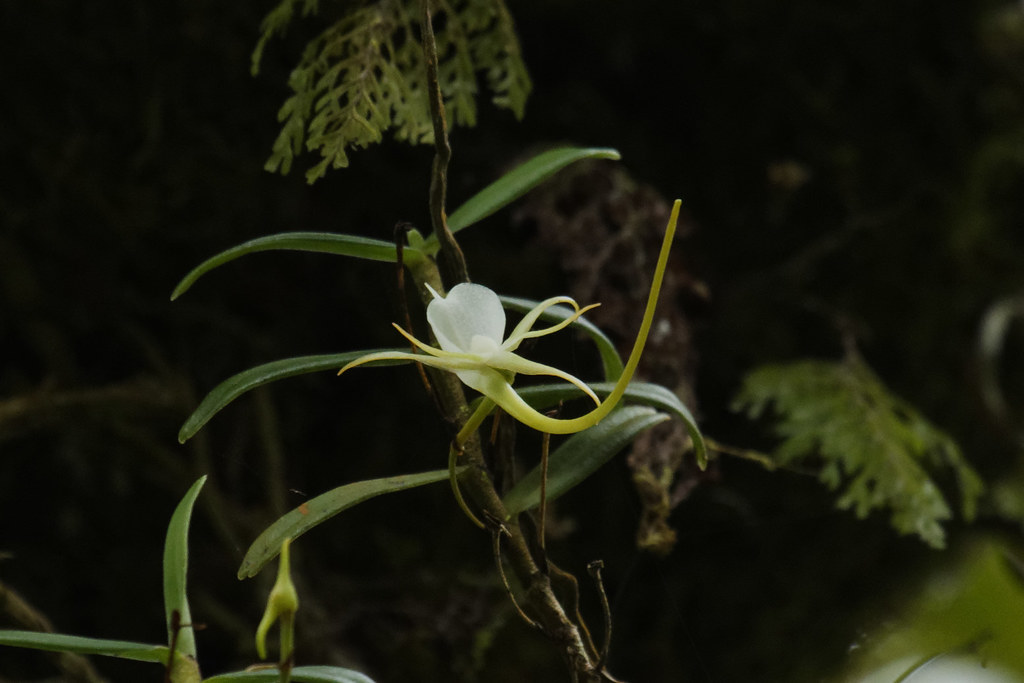
Growth habit: Epiphytic subshrub that clings to tree bark in humid forests. Plants are generally compact, forming short stems with a basal rosette of leaves.
Size: Mature individuals reach about 30 cm in height in the wild or in cultivation.[11]
Leaves: Leathery, linear‑oblong leaves arranged alternately along the stem; leaf length and width are not specifically documented.
Roots: Aerial, velamen‑covered roots typical of epiphytic orchids.
Flowers: The species bears white to greenish flowers; fragrance is reported as present. Specific measurements of the lip, spur, or overall flower size are not provided in the available sources.[11]
Because several Angraecum species share a white, fragrant flower, identification should be confirmed with a herbarium specimen or a reliable photographic reference that shows the floral morphology (especially the lip shape and spur length).
Native Range and Habitat
Angraecum expansum is native to the islands of Réunion and Mauritius in the western Indian Ocean, part of the Mascarene Islands.[1] In the wild it occurs as an epiphyte on moist, evergreen forest trees, preferring the wet tropical biome. The species is recorded at low to mid elevations across the islands, but precise altitude limits are not detailed in the sources.
The habitat is characterized by high humidity, frequent mist, and a stable warm temperature regime typical of tropical montane forests.
Species‑Specific Care
| Factor | Documented guidance | Source |
|---|---|---|
| Temperature | Not documented for cultivation; native habitat is warm and humid. | — |
| Light | Not documented; epiphytic habit suggests bright, filtered light. | — |
| Watering | Not documented; native wet forest implies regular moisture. | — |
| Humidity | Not documented; high ambient humidity is typical of its natural environment. | — |
| Mounting / Potting | Not documented; epiphytic growth indicates mounting on bark or using a very coarse, well‑draining medium. | — |
| Feeding | Not documented. | — |
| Repotting | Not documented. | — |
| Seasonal changes | Not documented; wild plants experience little seasonal temperature variation. | — |
Because specific horticultural data are lacking, growers should start with the general requirements for epiphytic Angraecum species: warm temperatures (18–28 °C), bright indirect light, frequent misting, and a well‑aerated medium such as bark slabs or coarse orchid mix. Monitor the plant for signs of stress and adjust watering and humidity accordingly.
Flowering and Pollination
Flowering time is not recorded in the primary taxonomic literature. A horticultural source notes that the plant may produce flowers throughout the year, but this observation lacks formal citation.[11] The flowers are described as white to greenish and scented, traits that in other Angraecum species are associated with moth pollination, yet no pollinator study is available for A. expansum.
Conservation and Responsible Cultivation
The regional conservation assessment for Réunion lists the taxon as “LC – taxon de préoccupation mineure” (Least Concern).[7] While the species is not currently considered threatened, habitat loss on the Mascarene Islands could affect local populations. Cultivators should obtain plants from reputable, legally compliant sources and avoid wild collection.
Evidence and Limitations
Most botanical information (accepted name, native range, synonymy, growth habit) is drawn from Kew’s Plants of the World Online and the Mascarine flora database. Detailed morphological measurements, precise elevation range, and species‑specific horticultural protocols are not documented in the available sources. Consequently, the care recommendations are based on general epiphytic Angraecum guidelines rather than proven experiments with A. expansum. Further field studies and cultivated observations are needed to refine these aspects.
FOLLOW THE EVIDENCE
Sources & references
- Angraecum expansum Thouars | Plants of the World Online | Kew Science, https://powo.science.kew.org/taxon/urn:lsid:ipni.org:names:616114-1
- International Plant Names Index – Angraecum expansum, https://www.ipni.org/n/616114-1
- Index de la flore – Angraecum expansum – Mascarine, https://mascarine.cbnm.org/index.php/flore/index-de-la-flore/nom?code_taxref=707184
- Angraecum expansum | NativePlants.info, https://www.nativeplants.info/plant/magnoliophyta-flowering-plants/orchidaceae/angraecum/angraecum_expansum.html
- World Flora Online snapshot for Angraecum expansum, https://wfoplantlist.org/taxon/wfo-0000976873-2023-12