At a glance
RECORDED PROFILE DATA- Scientific name
- Angraecum dendrobiopsis Schltr.
- Name status
- Accepted
- Native region
- Madagascar
- Growth habit
- Epiphytic
- Cultivation temperature group
- Cool / temperate (requires winter chill 10‑12 °C nights)
Names and Taxonomy
Angraecum dendrobiopsis Schltr. was described in 1925 (source [4]). Current taxonomic databases list it as an accepted species within the genus Angraecum (source [5]). No synonyms or alternative spellings were found in the available sources.
How to Identify This Species
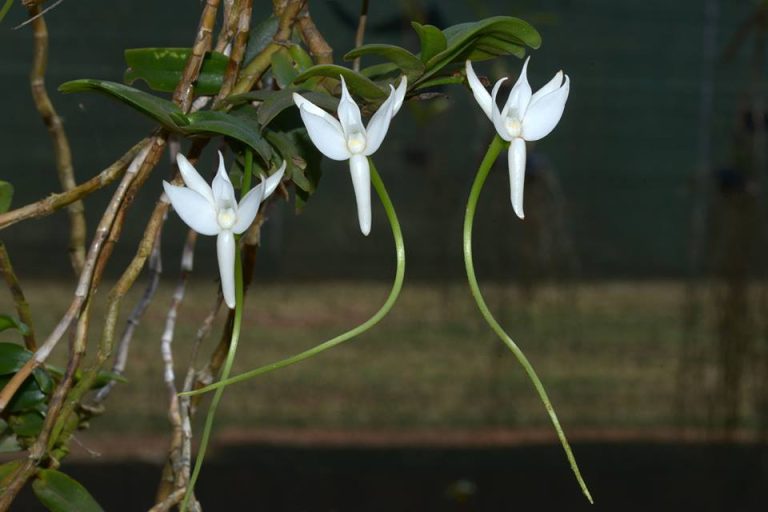
This orchid is a pendant‑stem epiphyte. Stems are thin, up to about 15 cm long, bearing linear‑lanceolate leaves that are unequally bilobed at the apex. Plants reach roughly 30 cm in height (source [3]). Flowering occurs on a short raceme 4–12 cm long, bearing 1–4 fleshy flowers. Each flower is about 5 cm (2 in) across, white to greenish‑white, and fragrant (source [2]). The lip is modestly sized with a short spur; the overall habit resembles a small Dendrobium, which is reflected in its common name “the Dendrobium‑like Angraecum” (source [2]).
Native Range and Habitat
Angraecum dendrobiopsis is endemic to Madagascar, specifically the northern mountainous regions such as the Tsaratana Massif (source [6]). It grows epiphytically on moss‑ and lichen‑covered tree trunks in mossy rainforests at elevations of 1 000–2 000 m (source [2]; also 1 500–2 000 m per field notes in source [6]). The high‑altitude environment provides cool nights and frequent mist.
Species‑Specific Care
| Factor | Documented guidance | Evidence |
|---|---|---|
| Light | Intermediate light (≈15 000–20 000 lux) | source [6] |
| Temperature | Cool to temperate; winter nights 10–12 °C, days 15–17 °C; summer 18–24 °C | source [6] |
| Humidity | High humidity; mimics misty montane forest | source [6] |
| Mounting / Potting | Can be mounted on bark; if potted, use a coarse bark medium | source [6] |
| Watering | Abundant water in summer; reduce watering in winter | source [6] |
| Fertilising | Regular balanced orchid fertilizer during active growth | Not documented – general orchid practice |
| Rest period | Cool, drier winter period encourages flowering | source [6] |
In practice, growers often mount the plant on a slab of bark to accommodate its pendant stem and thin roots. Provide good air circulation to prevent rot, especially during the drier winter phase. Maintaining the cool night temperatures noted above is critical; without the winter chill the plant may fail to flower (source [6]).
Flowering and Pollination
Flowers appear in the summer months in the wild and can be induced to bloom in cultivation after a proper winter chill (source [6]). Each flower lasts several weeks and emits a subtle fragrance, described as white‑greenish scented (source [2]; also noted as fragrant in source [3]). Specific pollinators have not been documented for this species; the morphology (short spur, modest size) suggests moth pollination, but this remains a hypothesis pending field observation.
Evidence and Limitations
The profile relies on a limited set of web‑based sources. Detailed morphometric data (e.g., precise leaf dimensions, exact spur length) and formal conservation assessments are not available in the consulted material. Pollination biology is inferred from flower form and lacks direct observation. Growers should treat the cultivation advice as a guideline derived from a single horticultural report and may need to adjust conditions based on individual plant response.
Frequently asked questions
What light level does Angraecum dendrobiopsis need?
Intermediate light of about 15 000–20 000 lux is recommended, replicating the filtered canopy of its montane forest habitat (source [6]).
Can this species be grown mounted?
Yes. Because it has a pendant stem and thin roots, mounting on a bark slab is often preferred; if potted, use a coarse bark medium (source [6]).
When does Angraecum dendrobiopsis flower in cultivation?
Flowering can be induced after a cool winter period (10–12 °C nights). In the wild it blooms in the summer, and cultivated plants often follow a similar schedule after the chill (source [6]).
FOLLOW THE EVIDENCE
Sources & references
- IOSPE PHOTOS – Angraecum dendrobiopsis, https://www.orchidspecies.com/angdendrobiopsis.htm
- Angraecoid orchids: Angraecum dendrobiopsis Schltr. (1925), http://angraecoid-orchids.blogspot.com/2016/03/angraecum-dendrobiopsis-schltr-1925.html
- Angraecum dendrobiopsis – NativePlants.info, https://www.nativeplants.info/plant/magnoliophyta-flowering-plants/orchidaceae/angraecum/angraecum_dendrobiopsis.html
- Angraecum dendrobiopsis (Baillon ex Finet) Schlechter – Coocan.jp, http://orchids.la.coocan.jp/Angraecum/Angraecumdendrobiopsis/Angraecumdendrobiopsis.htm
- Angraecum dendrobiopsis – MNHN specimen database, https://science.mnhn.fr/taxon/species/angraecum/dendrobiopsis