At a glance
RECORDED PROFILE DATA- Scientific name
- Angraecum angustipetalum Rendle
- Name status
- Accepted
- Native region
- West Tropical Africa, West‑Central Tropical Africa, South Tropical Africa
- Growth habit
- Epiphytic subshrub
- Cultivation temperature group
- Not documented
Names and Taxonomy
The accepted name for this orchid is Angraecum angustipetalum Rendle. The name was first published in Catalogue of the Plants of Oban 106 (1913) and is listed as an accepted species by Kew’s Plants of the World Online.[1] Documented synonyms include:
- Angraecoides angustipetala (Rendle) Szlach., Mytnik & Grochocka (2013)
- Conchograecum angustipetalum (Rendle) Szlach., Grochocka, Olędrz. & Mytnik (2018)
- Angraecum boonei De Wild. (1916) (heterotypic synonym)
Commonly referred to as “The Narrow Petal Angraecum” in horticultural literature.[8]
How to Identify This Species
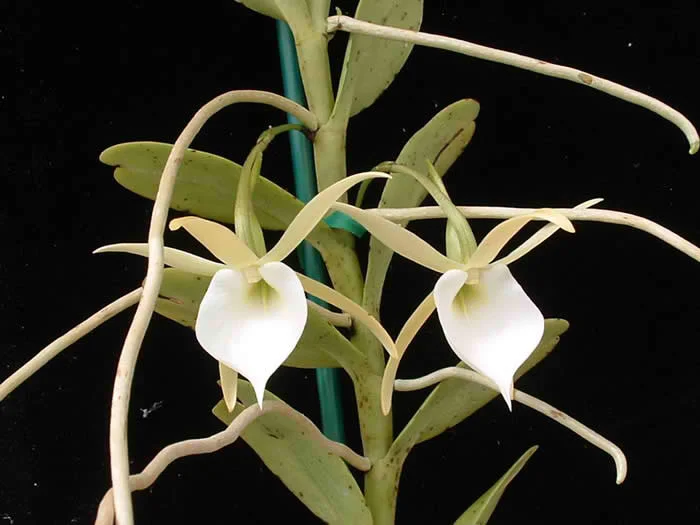
Growth habit: epiphytic subshrub forming a pendant, straight‑to‑curved stem that is often sheathed by leaf‑bearing bases.
Leaves: arranged in two ranks, ovate to elliptic, with a marked unequal bilobed apex.
Inflorescence: typically a single flower borne on a short spike arising just above the roots.
Flower: white to greenish‑white, about 1.4 in (3.5 cm) across, with a narrow lip (hence the common name). The flower is fragrant, especially in the evening.[8]
Size: mature plants reach roughly 30 cm in height (including the stem).[12]
Because many Angraecum species have similar single‑flowered inflorescences, identification should be confirmed with a herbarium specimen or reliable photograph that shows the distinctive narrow lip and leaf shape.
Native Range and Habitat
Geographic distribution: West Tropical Africa and West‑Central Tropical Africa extending eastward to Malawi. Documented native countries are Cameroon, the Democratic Republic of the Congo, Gabon, Ghana, Liberia, Malawi, and Nigeria.[1]
Habitat: dense evergreen forest, usually as an epiphyte on tree trunks and large branches. The species prefers the seasonally dry tropical biome, thriving in humid, warm forest layers.
Elevation: Not documented in the available sources.
Species‑Specific Care
| Factor | Documented guidance | Evidence |
|---|---|---|
| Temperature | Not documented | — |
| Light | Not documented | — |
| Watering | Not documented | — |
| Humidity | Not documented | — |
| Substrate / Mounting | Epiphytic – typically grown on bark slabs or in well‑aerated orchid mix. | Inferred from native habit (epiphyte) [1] |
| Fertilisation | Not documented | — |
| Repotting / Re‑mounting | Not documented | — |
| Seasonal changes | Not documented | — |
Because specific cultural requirements for A. angustipetalum have not been published, growers generally apply the standard practices used for warm‑growing epiphytic Angraecum species: bright, filtered light; high humidity; regular watering allowing the medium to dry slightly between waterings; and mounting on bark or using a coarse orchid mix. These suggestions are based on the species’ natural forest habitat rather than direct cultivation studies.
Flowering and Pollination
The plant flowers in late spring to early summer, producing a single fragrant white‑green flower that may persist for several weeks.[8] No pollinator has been recorded for this species in the literature; the long nectar spur typical of many Angraecum suggests moth pollination, but this remains a hypothesis.
Evidence and Limitations
The profile relies on taxonomic and distribution data from Kew’s Plants of the World Online and morphological details from the IOSPE orchid photo database. Detailed measurements of plant height, leaf dimensions, and precise elevation range are not available in the cited sources. Cultivation recommendations are therefore extrapolated from the species’ epiphytic habit and from general Angraecum guidelines; specific temperature, light, and watering regimes for A. angustipetalum have not been published.
FOLLOW THE EVIDENCE
Sources & references
- Angraecum angustipetalum Rendle | Plants of the World Online | Kew Science, https://powo.science.kew.org/taxon/urn:lsid:ipni.org:names:615936-1
- Angraecum angustipetalum – IOSPE PHOTOS, https://www.orchidspecies.com/angangustpetalum.htm
- Angraecum angustipetalum (Angraecum angustipetalum) | NativePlants.info, https://www.nativeplants.info/plant/magnoliophyta-flowering-plants/orchidaceae/angraecum/angraecum_angustipetalum.html