At a glance
RECORDED PROFILE DATA- Scientific name
- Angraecum reygaertii De Wild.
- Name status
- Accepted name (Kew POWO)
- Native region
- Cameroon, DR Congo, Uganda
- Growth habit
- Epiphytic subshrub
- Cultivation temperature group
- Not documented
Names and Taxonomy
The accepted name for this orchid is Angraecum reygaertii De Wild. It was first described in Bulletin du Jardin Botanique de l’État à Bruxelles 5:190 (1916) and is listed as an accepted species by Kew’s Plants of the World Online.[1] A later homotypic synonym is Conchograecum reygaertii (De Wild.) Szlach., Grochocka, Olędrz. & Mytnik (2018). No other synonyms or varietal names are documented.
Common names have not been recorded in the available sources, and the species is not listed under any horticultural trade name.
How to Identify This Species
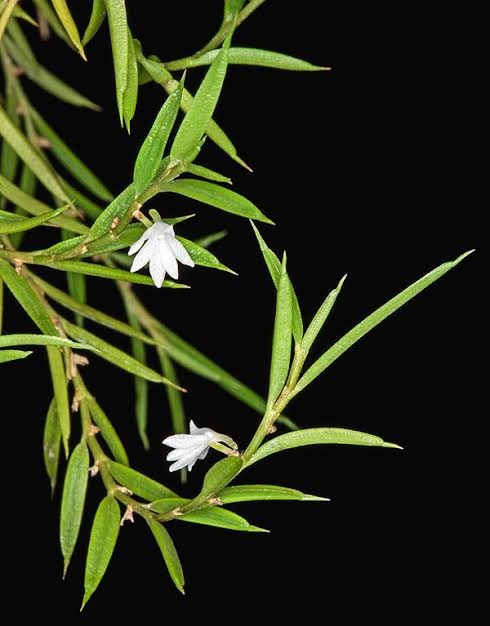
Growth habit: A small epiphytic subshrub that attaches to tree bark or branches. Height reaches about 30 cm in the wild.[3]
Leaves: Linear‑elliptic, arranged along a short stem, typical of many Angraecum species. Detailed leaf measurements are not documented in the sources.
Roots: Aerial roots with a velamen layer, characteristic of epiphytic orchids, allowing absorption of moisture from the humid forest air. No specific description is provided.
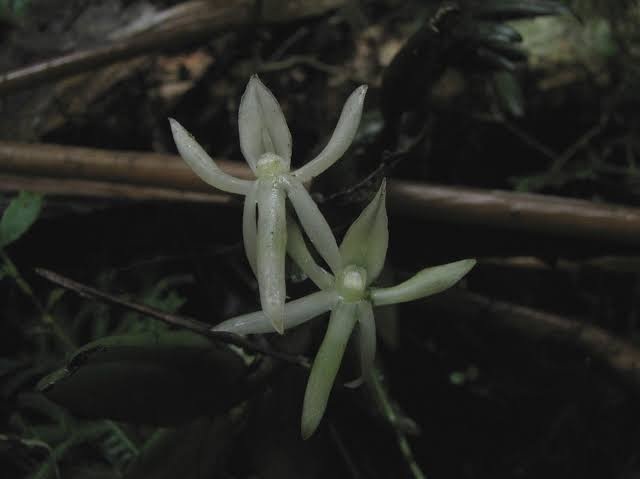
Flowers: White, fragrant, and reported to bloom throughout the year (January – December). Individual flower size is not given, but the overall inflorescence is modest, matching the plant’s 30 cm stature.[3]
Diagnostic features: The combination of a compact epiphytic habit, year‑round white fragrant flowers, and a native range limited to Central‑East Africa helps separate A. reygaertii from similar continental species such as Angraecum firthii (which extends into Kenya) and Angraecum affine (wider West‑tropical African distribution). However, without floral measurements or a detailed lip‑spur description, identification from photographs alone should be made cautiously.
Native Range and Habitat
According to Kew, the native distribution of Angraecum reygaertii spans Cameroon, the Democratic Republic of Congo, and Uganda – effectively “Cameroon to Uganda.”[1] The species occurs in the seasonally dry tropical biome, growing as an epiphyte on trees in forested areas that experience a marked dry season.[1]
Elevation data are not provided in the cited references, nor are specific host tree species. The plant is described as an epiphytic subshrub, indicating it does not grow on the forest floor but relies on arboreal substrates.
Species‑Specific Care
| Factor | Documented guidance | Source |
|---|---|---|
| Growth habit | Epiphytic – mount on bark or grow in a very well‑draining medium that mimics tree branches. | [1][3] |
| Light | Bright, filtered light; direct midday sun is likely too intense for a forest‑dwelling epiphyte. | Not documented – inferred from habitat description. |
| Watering | Keep substrate moist but allow quick drying between waterings; the species is noted as having low drought tolerance. | [3] |
| Humidity | High humidity (≥70 %) is typical for tropical epiphytes; no specific measurement recorded for this species. | Not documented. |
| Temperature | Not documented for this species; growers should approximate temperatures of lowland Central‑East African forests (≈20‑28 °C day). | Not documented. |
| Fertiliser | Use a balanced orchid fertilizer at half strength during active growth; specific studies on A. reygaertii are lacking. | Not documented. |
| Repotting / Re‑mounting | Repot or re‑mount when roots outgrow the medium, typically every 2–3 years for small epiphytes. | Not documented. |
| Seasonal rest | Not documented; some Angraecum species reduce growth in the dry season, but this has not been recorded for A. reygaertii. | Not documented. |
Because specific horticultural trials for Angraecum reygaertii are scarce, growers should start with the general care guidelines for small, low‑drought‑tolerant Angraecum epiphytes and adjust based on plant response.
Flowering and Pollination
Flowering is reported to occur throughout the year, with blooms recorded in every month from January to December.[3] The flowers are white and fragrant; the fragrance is noted but the timing (day/night) is not specified.
No pollinator observations are documented for this species. The presence of a nectar spur (a common feature in Angraecum) suggests moth pollination, but without empirical data this remains a hypothesis.
Evidence and Limitations
Most of the species‑specific information comes from taxonomic databases (Kew POWO) and a brief horticultural summary on NativePlants.info. Detailed morphological measurements, precise elevation range, specific pollinator records, and rigorous cultivation trials are absent. Consequently, many care recommendations are based on general Angraecum horticulture rather than direct evidence for A. reygaertii. Further field studies and cultivated observations are needed to refine the profile.
Frequently asked questions
Is Angraecum reygaertii fragrant?
Yes. The species is described as having fragrant white flowers in the NativePlants.info entry.
What size does Angraecum reygaertii reach in cultivation?
In the wild it grows to about 30 cm tall; cultivated size is expected to be similar, but specific horticultural measurements are not documented.
FOLLOW THE EVIDENCE
Sources & references
- Angraecum reygaertii De Wild. | Plants of the World Online | Kew Science, https://powo.science.kew.org/taxon/urn:lsid:ipni.org:names:616371-1
- Angraecum reygaertii (Angraecum reygaertii) | NativePlants.info, https://www.nativeplants.info/plant/magnoliophyta-flowering-plants/orchidaceae/angraecum/angraecum_reygaertii.html
- Angraecum reygaertii - orchidroots, https://orchidroots.com/display/summary/orchidaceae/9640/
- Angraecum | Clan Orchids Compendium, http://www.clanorchids.com/compendium/page3a.html