At a glance
RECORDED PROFILE DATA- Scientific name
- Angraecum liliodorum Frapp. ex Cordem.
- Name status
- Accepted
- Native region
- Réunion
- Growth habit
- Epiphytic subshrub (epiphyte)
- Cultivation temperature group
- Warm (hot) – 18–30 °C
How to Identify This Species
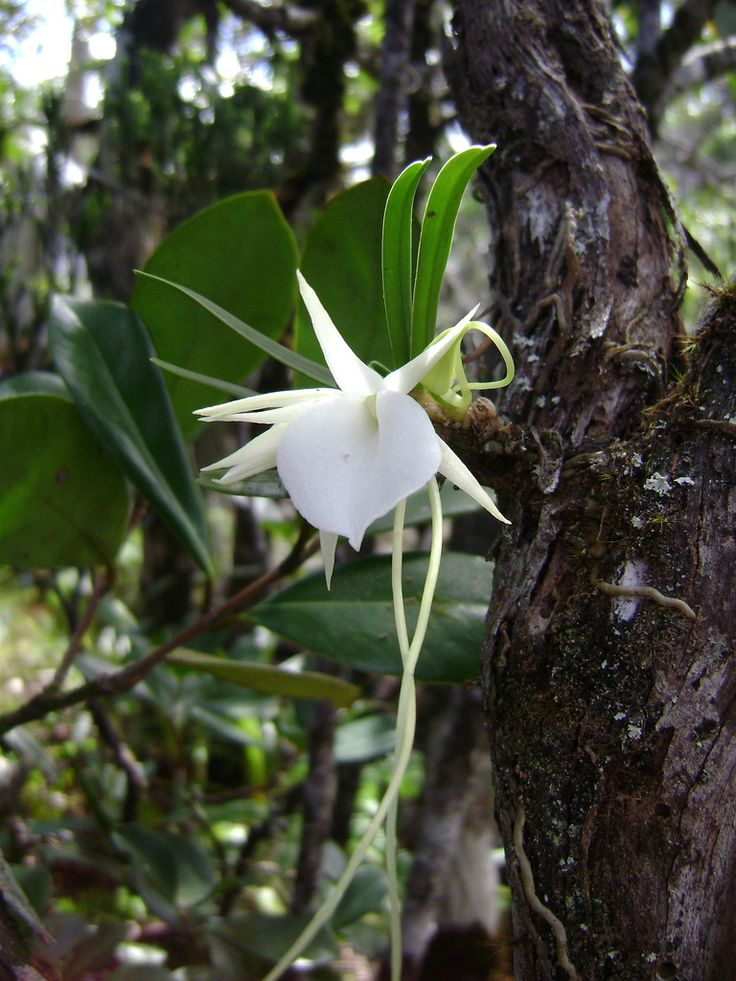
Angraecum liliodorum is a miniature epiphytic orchid forming a short, compact stem that bears a single inflorescence. The plant typically carries 5–9 leathery, dark‑green leaves arranged in two ranks. Leaves are 50–60 mm long and 12–15 mm wide, elliptic to oblong [5]. The sole flower is white, lily‑scented, and measures about 5–6 cm across (overall flower size) [7]. Diagnostic floral parts include:
- Dorsal sepal: lanceolate, 23–28 mm × 4–5 mm [5]
- Lateral sepals: similar size, 23–26 mm × 4–5 mm [5]
- Petal: lanceolate, 20–26 mm × 3–5 mm [5]
- Labellum (lip): ovate, 20–26 mm × 11–14 mm, slightly up‑curved [5]
- Spur: slender, 50–60 mm long, curving downward [5]
The flower emits a strong lily‑like fragrance, most intense at night [7]. The plant grows to a modest height of 10–20 cm in the wild, with a well‑developed velamen‑covered root system that adheres tightly to tree bark or rocks [5][6]. Because the species is rare and often confused with other small Angraecum taxa, a combination of leaf size, single white flower with a long spur, and the specific altitudinal range helps confirm identification.
Native Range and Habitat
This orchid is endemic to the island of Réunion in the western Indian Ocean. It occurs in shady, humid forest fragments across the island, from sea level up to about 500 m elevation [4][5][6]. It is recorded as an epiphyte on tree trunks and occasionally as a lithophyte on rock outcrops [5][6]. Flowering in the wild is reported from May to July (late autumn in the Southern Hemisphere) [5][6]. The species is considered very rare in the field; the regional flora lists it as vulnerable (VU) and notes that it is protected under a 1987 ministerial decree [5]. A later taxonomic treatment classifies it as Endangered (EN) based on limited population size and habitat loss [6]. The plant is listed in CITES Appendix II, regulating international trade [2].
Species‑Specific Care
| Factor | Documented guidance | Source |
|---|---|---|
| Light | Bright, indirect or filtered light; mimics shaded humid forest canopy. | [7][8] |
| Temperature | Warm to hot; 18–30 °C recommended. | [8] |
| Humidity | Maintain 60–80 % relative humidity. | [8] |
| Watering | Not documented in the available sources. | Not documented |
| Growing medium | Epiphytic mounting on coarse bark or tree‑mount; specific medium not documented. | Not documented |
| Airflow | Good air circulation is implied by its forest habitat, but no explicit guidance. | Not documented |
| Feeding | Fertiliser regime not documented. | Not documented |
| Seasonal changes | No documented rest period; treat as a warm‑growing orchid. | Not documented |
In practice, growers who have successfully cultivated Angraecum liliodorum report treating it as a “hot‑growing” epiphyte, providing high humidity, warm temperatures, and bright but diffused light, and mounting the plant on a bark slab or in a well‑aerated orchid mix. Water when the mounting medium begins to dry, avoiding prolonged soggy conditions that can cause root rot. Because the species is rare in the wild, propagation is usually performed via seed in sterile culture rather than division.

Flowering and Pollination
Wild plants flower from May through July, producing a single white flower that releases a strong lily scent, especially after dusk [5][7]. The long, slender spur (50–60 mm) suggests pollination by a nocturnal moth with a proboscis of comparable length, a pattern common in many Angraecum species, but no direct pollinator observations have been published for A. liliodorum Not documented. Flowers are short‑lived, typically persisting for a few days, after which a capsule forms and releases minute seeds that are wind‑dispersed.
Conservation and Responsible Cultivation
The species is listed as Vulnerable on the regional Red List of Réunion and as Endangered in a 2020 taxonomic assessment, reflecting its limited distribution, small population size, and ongoing habitat pressure [5][6]. International trade is regulated under CITES Appendix II [2]. Cultivators are encouraged to obtain plants from reputable, legally compliant sources and to support in‑situ conservation programmes that protect Réunion’s remaining humid forest habitats.
Evidence and Limitations
Most morphological data come from herbarium descriptions and limited field observations; precise horticultural parameters such as watering frequency, fertilisation regime, and optimal potting media are not documented in the available literature. Pollinator identity remains unverified. Conservation assessments differ between “Vulnerable” and “Endangered,” indicating a need for updated population studies. Further field research would clarify ecological requirements and improve cultivation guidelines.
FOLLOW THE EVIDENCE
Sources & references
- Angraecum liliodorum Frapp. ex Cordem. | Plants of the World Online | Kew Science – https://powo.science.kew.org/taxon/urn:lsid:ipni.org:names:616230-1
- Angraecum liliodorum – Wikipedia (French) – https://fr.wikipedia.org/wiki/Angraecum_liliodorum
- Angraecum liliodorum | atlas - SINP de La Réunion – https://geonature.borbonica.re/atlas/espece/705838
- Index de la flore – Angraecum liliodorum – https://mascarine.cbnm.org/index.php/flore/index-de-la-flore/nom?code_taxref=705838
- Limodore – Auteur Angraecum liliodorum – https://limodore.france-orchidees.org/angraecum/angraecum-liliodorum/angraecum-liliodorum.html
- Angraecum liliodorum Frappier – Biodiversity Literature Repository – https://doi.org/10.5281/zenodo.13878520
- IOSPE PHOTOS – Angraecum liliodorum – https://orchidspecies.com/angliliodorum.htm
- 百合香风兰 Angraecum liliodorum | Tropicals.cn – https://tropicals.cn/species/angraecum-liliodorum