At a glance
RECORDED PROFILE DATA- Scientific name
- Angraecum erectum Summerh.
- Name status
- Accepted
- Native region
- East Tropical Africa, South Tropical Africa
- Growth habit
- Epiphytic scrambling subshrub
- Cultivation temperature group
- Cool to intermediate (12–24 °C)
Names and Taxonomy
Angraecum erectum Summerh. is the accepted name for this species according to Kew’s Plants of the World Online[1]. It was first published in Kew Bulletin 11:232 (1956). Synonyms recorded in recent taxonomic revisions include Angraecoides erecta (Summerh.) Szlach., Mytnik & Grochocka (2013) and Conchograecum erectum (Summerh.) Szlach., Grochocka, Olędrz. & Mytnik (2018)[5]. No common names are documented in the consulted sources.
How to Identify This Species
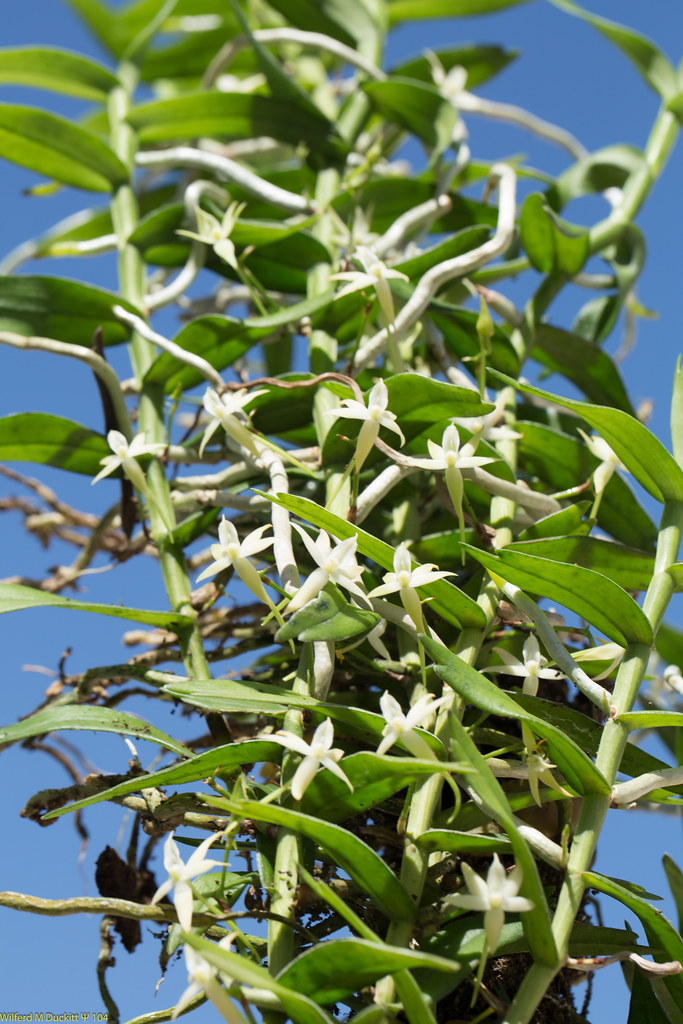
The plant is an epiphytic scrambling subshrub that climbs tree trunks or rocks, producing aerial roots along the entire length of the stem (observed by a grower in Florida)[3]. Stems are leafy and scandent, bearing distichous, oblong‑elliptical leaves of pale green colour (IOSPE description)[4]. The inflorescence arises from nodes on the stem, is 1.6–2 cm long, and carries one to two flowers[4]. Flowers are 1.5 in (≈3.5 cm) across, with colour ranging from yellow‑green to greenish‑white or a subdued salmon hue; they are nocturnally fragrant[4][3]. The lip is relatively broad, and a nectar spur is present, though its length is not documented. These characters together distinguish it from similar Angraecum species such as Angraecum conchiferum, which typically lacks the extensive aerial rooting pattern.
Native Range and Habitat
The species is native to East Tropical Africa (Kenya, Tanzania, Uganda) and South Tropical Africa (Zambia)[1][5]. It occurs in seasonally dry tropical forest and scrub habitats, often on tree trunks but also on rocks in forested gullies and along rivers[1][11]. Altitudinal distribution spans 1,300–2,350 m above sea level[3]. The climate of its native range is characterised by two wet and two dry seasons, each lasting roughly two to three months[3].
Species-Specific Care
| Factor | Documented guidance | Evidence |
|---|---|---|
| Temperature | Cool to intermediate; day 21–24 °C, night 11–14 °C reported from successful cultivation in South Florida | [3] |
| Light | Bright, filtered light; similar to forest canopy conditions | [3][4] |
| Watering | Water every 2–3 days during the dry (cooler) season and daily during the wet (warmer) season | [3] |
| Humidity | Moderate to high; the species originates from humid montane forests | Not documented directly; inferred from native habitat |
| Mounting / Medium | Mount on cork bark or coarse tree bark to accommodate aerial roots; a well‑draining epiphytic mix can be used for pot culture | [3][4] |
| Fertilisation | Balanced orchid fertilizer at half strength applied monthly during active growth | Not documented; general orchid practice |
| Repotting | Repot after 2–3 years or when roots outgrow the mount, using coarse bark and sphagnum | Not documented |
Growers who have successfully flowered the plant in subtropical climates note that maintaining a cool night period (around 12 °C) promotes flowering, likely reflecting the species’ montane origin[3]. Because the plant produces aerial roots along the stem, mounting on a vertical support that allows good air circulation is especially important.
Flowering and Pollination
Flowers open in the evening and emit a sweet fragrance throughout the night, a trait typical of moth‑pollinated Angraecums[4][3]. The exact flowering season in the wild has not been documented, and no specific pollinator has been recorded for this species. In cultivation, growers have reported blooming from spring through fall when temperature and watering regimes are followed[3].
Evidence and Limitations
The profile relies on a limited set of sources: taxonomic data from Kew (POWO) and Wikispecies, a horticultural blog providing altitude and cultivation observations, and an IOSPE entry offering morphological details. Formal ecological studies, precise measurements of plant size, spur length, and pollinator observations are absent from the available literature. Consequently, several cultivation recommendations are based on grower experience rather than peer‑reviewed research, and aspects such as humidity requirements, exact flowering period in the native range, and conservation status remain undocumented.
FOLLOW THE EVIDENCE
Sources & references
- Angraecum erectum Summerh. | Plants of the World Online | Kew Science, https://powo.science.kew.org/taxon/urn:lsid:ipni.org:names:616111-1
- Angraecum erectum – Wikispecies, https://species.wikimedia.org/wiki/Angraecum_erectum
- Angraecums blog post – Angraecum erectum, http://angraecums.blogspot.com/2015/01/angraecum-erectum.html
- Angraecum erectum – Internet Orchid Species Encyclopedia (IOSPE), http://www.orchids.org/grexes/angraecum-erectum
- Taxonomical notes on Angraecoid orchids from Africa, with a new genus and new combinations, https://richardiana.jardinbotaniquedeguyane.com/wp-content/uploads/2018/07/Publication-Jardin-botanique-de-Guyane-13-African-Angraecoid.pdf
