At a glance
RECORDED PROFILE DATA- Scientific name
- Angraecum eichlerianum var. curvicalcaratum Szlach. & Olszewski
- Name status
- Accepted variety (Kew POWO)
- Native region
- West-Central Tropical Africa (Cameroon, Gabon)
- Growth habit
- Epiphytic
- Cultivation temperature group
- Intermediate to hot
- Typical flower colour
- White
Names and Taxonomy
The accepted scientific name for this plant is Angraecum eichlerianum var. curvicalcaratum Szlach. & Olszewski. It is treated as a valid variety of Angraecum eichlerianum Kraenzl., a species native to West‑Central Africa [1]. The name was first published in Flora Cameroun 36: 898 (2001) and is accepted by both Kew’s Plants of the World Online and World Flora Online [9]. A later synonym, Eichlerangraecum eichlerianum var. curvicalcaratum (Szlach. & Olszewski) Szlach., Mytnik & Grochocka, appears in the 2013 taxonomic revision [1]. No common name is documented for this variety.
How to Identify This Species
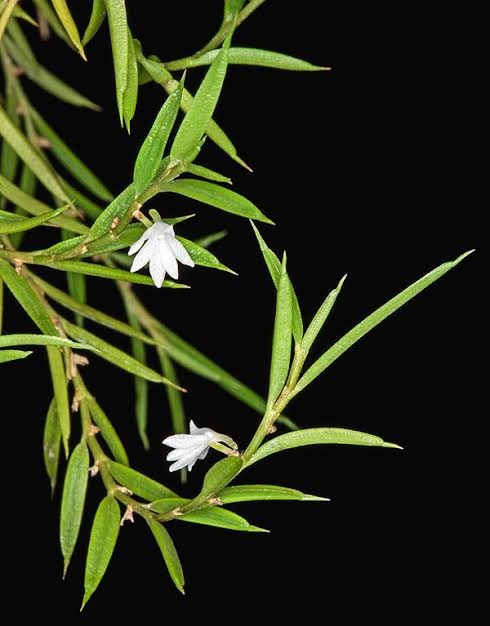
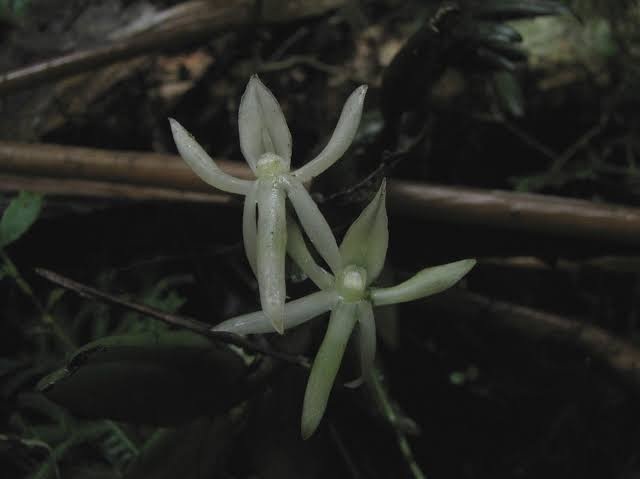
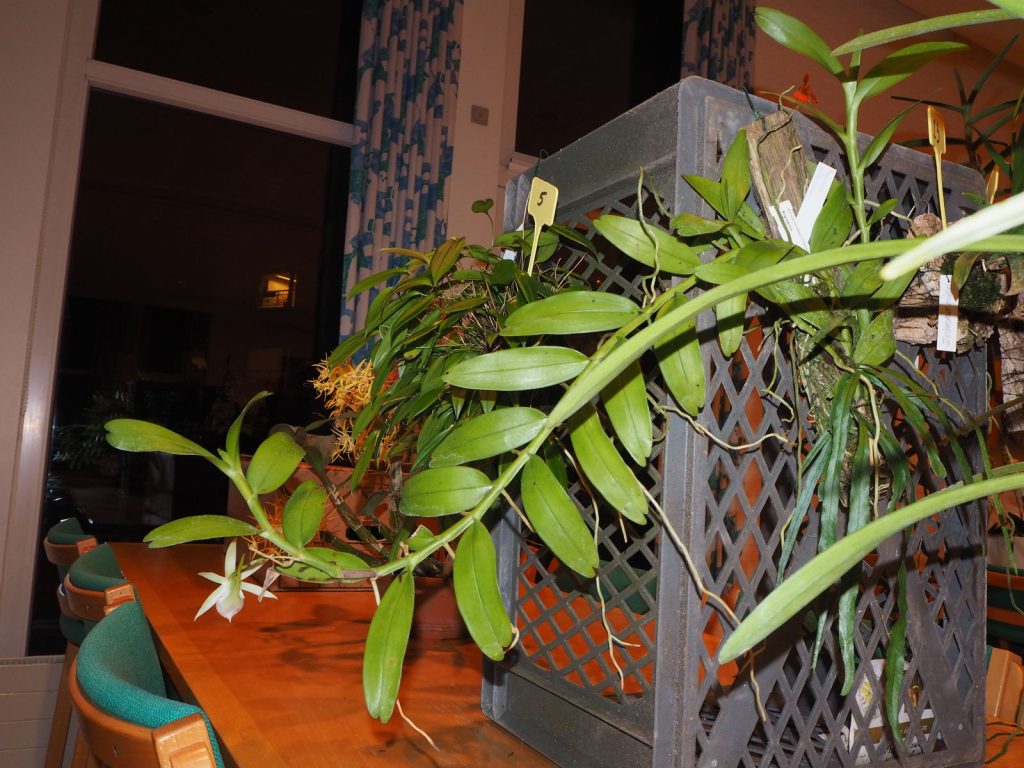
Like the nominal species, the variety is a large to giant‑sized epiphytic orchid with a monopodial growth habit. Stems are erect and can become long and vining, bearing distichously arranged, narrowly elliptic‑oblong leaves that range from about 1.5 cm to 15 cm in length [7]. The flowers are white with a fragrant jasmine‑to‑lily scent, typical of the species [4]. The spur measures roughly 3–4 cm in length, and the overall flower width can reach about 7.5 cm (3 in) [8]. Blooming occurs in the early summer (June–August) in its native range [4]. Because the variety is not frequently illustrated, identification should be confirmed by comparing leaf size, flower spur length, and fragrance with authenticated herbarium material.
Native Range and Habitat
The variety is recorded from Cameroon and Gabon, placing it in the West‑Central Tropical Africa region [1]. It inhabits lowland, wet tropical forests, typically at elevations around 150 m above sea level [8]. In the wild it grows as an epiphyte on the branches of mature trees, favouring humid, shaded canopy environments.
Species‑Specific Care
| Factor | Documented guidance | Evidence |
|---|---|---|
| Light | Bright, filtered light; avoid direct midday sun | [7] |
| Temperature | Intermediate to hot; 16 °C–30 °C (60 °F–86 °F) | [7] |
| Watering | Keep medium moist; water regularly, allowing excess to drain. Tolerates short dry periods (medium drought tolerance). | [4] |
| Humidity | Medium humidity; 50 %–70 % relative humidity is suitable. | [4] |
| Mounting / Potting | Can be grown mounted on bark or in a well‑draining epiphytic mix (bark, charcoal, perlite). | [4, 7] |
| Fertilisation | Not documented for this variety; apply a balanced orchid fertilizer at half strength during active growth. | Not documented |
| Seasonal changes | Maintain summer temperatures and regular watering to encourage flowering; no specific rest period documented. | Not documented |
In practice, growers report successful cultivation when the plant receives ample air circulation and is mounted on bark slabs, mimicking its natural epiphytic habit [4]. Because the species prefers a warm environment, avoid exposing it to temperatures below 15 °C for prolonged periods.

Flowering and Pollination
Flowers open in the early summer months (June–August) in Cameroon and Gabon [4]. The blossoms are long‑lasting and emit a strong jasmine‑to‑lily fragrance, a trait that typically attracts nocturnal moth pollinators in related Angraecum species, but specific pollinators for this variety have not been documented.
Conservation and Responsible Cultivation
An IUCN Red List assessment exists for Angraecum eichlerianum var. curvicalcaratum (2021), but the snippet does not provide the conservation category [10]. Collectors should ensure that any material obtained comes from legally sourced, cultivated stock rather than wild collection, given the species’ limited distribution.
Evidence and Limitations
Most morphological details (flower size, spur length) derive from descriptions of the broader species, not the variety specifically. Direct measurements for var. curvicalcaratum are lacking, as are data on pollinators, precise humidity requirements, and fertilisation regimes. Future field studies and cultivated observations are needed to refine these aspects.
Frequently asked questions
What light conditions does this variety need?
Bright, filtered light is recommended; direct midday sun should be avoided. This matches observations for the species in cultivation [7].
Can Angraecum eichlerianum var. curvicalcaratum be grown mounted?
Yes. It is an epiphyte and can be mounted on bark or grown in a well‑draining epiphytic mix, as reported by growers [4].
When does this orchid flower in cultivation?
Flowering has been recorded in the early summer months (June–August) in its native range [4].
FOLLOW THE EVIDENCE
Sources & references
- Angraecum eichlerianum Kraenzl. | Plants of the World Online | Kew Science, https://powo.science.kew.org/taxon/616100-1
- Angraecum eichlerianum var. curvicalcaratum | NativePlants.info, https://www.nativeplants.info/plant/magnoliophyta-flowering-plants/orchidaceae/angraecum/angraecum_eichlerianum_var-curvicalcaratum_237236.html
- CITES Orchid Checklist – Distribution data, https://www.kew.org/sites/default/files/PART_II_Names_in_current_use.pdf
- Angraecum eichlerianum « orchid.guru », https://orchid.guru/content/orchids/a/angraecum/eichlerianum/
- IOSPE PHOTOS – Angraecum eichlerianum, http://www.orchidspecies.com/angreichlerianum.htm
- WFO Plant List – World Flora Online entry for Angraecum eichlerianum var. curvicalcaratum, https://wfoplantlist.org/taxon/wfo-0001376282-2024-06
- IUCN Red List of Threatened Species – Angraecum eichlerianum var. curvicalcaratum, https://doi.org/10.2305/iucn.uk.2021-3.rlts.t87583861a87739892.en