At a glance
RECORDED PROFILE DATA- Scientific name
- Angraecum cribbianum Szlach. & Olszewski
- Name status
- Accepted
- Native region
- Gabon, Democratic Republic of Congo
- Growth habit
- Epiphytic subshrub
- Cultivation temperature group
- Not documented
Names and Taxonomy
The accepted scientific name for this species is Angraecum cribbianum Szlach. & Olszewski. It was first described in Flora Cameroun 36: 903 (2001) and is listed as an accepted name by Kew’s Plants of the World Online.[1] A later homotypic synonym is Conchograecum cribbianum (Szlach. & Olszewski) Szlach., Grochocka, Olędrz. & Mytnik (2018). No common names are recorded in the available sources.
How to Identify This Species
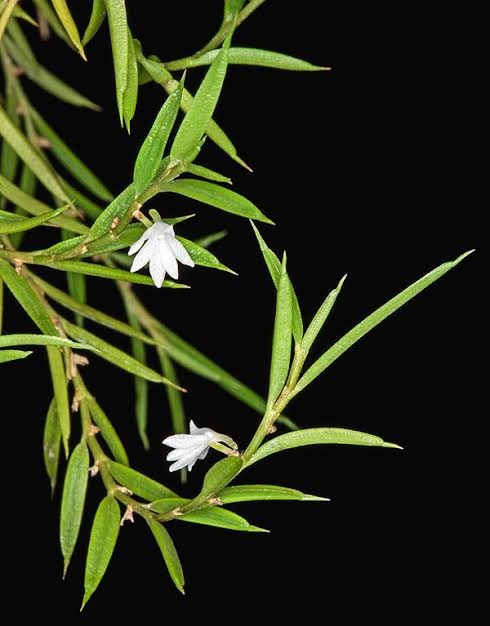
Growth habit: A small epiphytic subshrub that attaches to tree branches. Reported mature height is about 30 cm.[2]
Leaves and stems: Detailed leaf morphology is not documented in the sources consulted. As with many Angraecum species, leaves are expected to be narrow, leathery, and arranged alternately along a short, unbranched stem, but verification for A. cribbianum is lacking.
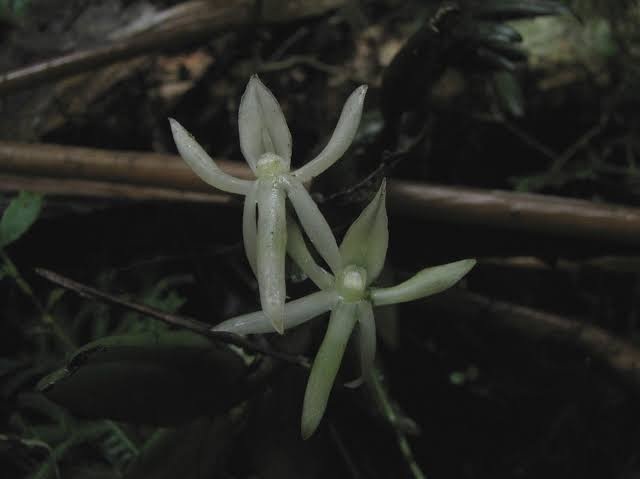
Flowers: The species produces white to greenish flowers that are noted as fragrant. NativePlants.info lists the bloom colour as “white, green” and confirms fragrance.[2] The timing of fragrance (e.g., nocturnal) and precise dimensions of the lip, spur, or overall flower are not documented.
Diagnostic comparison: In a 2017 taxonomic treatment of the section Afrangraecum, A. cribbianum is mentioned as a reference point for distinguishing three newly described Gabonese species, indicating that it shares a general morphology with other members of the section but has distinct, yet undocumented, characters.[3]
Native Range and Habitat
The species is native to the lowland wet tropical biome of West‑Central Africa, specifically Gabon and the Democratic Republic of Congo.[1] It grows as an epiphyte on tree trunks and large branches in humid forest environments. Elevational limits, precise forest type (e.g., primary vs. secondary), and host tree preferences are not recorded in the available literature.
Species‑Specific Care
| Factor | Documented guidance | Source |
|---|---|---|
| Growth habit | Epiphytic; mount on bark or grow in a very coarse, well‑draining orchid mix. | [2] |
| Watering | Low drought tolerance – keep the medium consistently moist but not water‑logged. | [2] |
| Light | Not documented; recommend bright, filtered light typical for lowland tropical epiphytes. | Not documented |
| Temperature | Not documented; native lowland tropical climate suggests warm temperatures (≈23‑30 °C) but no specific data. | Not documented |
| Humidity | Not documented; wet tropical habitat implies high humidity (≥70 %). | Not documented |
| Fertilisation | Not documented; a balanced orchid fertilizer at half strength during active growth is a common practice but not species‑specific. | Not documented |
| Seasonal changes | Not documented; the species is reported to flower throughout the year, suggesting no strict rest period. | [2] |
In cultivation, the most critical requirement is maintaining steady moisture and high humidity, reflecting the plant’s low drought tolerance and origin in a continuously wet forest. Growers should monitor for root rot if the medium stays overly wet; a well‑aerated bark mix can mitigate this risk.
Flowering and Pollination
NativePlants.info records that A. cribbianum can bloom in any month of the year, indicating a potentially continuous flowering cycle in its native habitat.[2] Flowers are fragrant, but the timing of scent release (day vs. night) has not been documented. No pollinator observations are available; the presence of a nectar spur typical of Angraecum species suggests moth pollination, but this remains a hypothesis until field studies are published.
Conservation and Responsible Cultivation
The IUCN Red List entry for this taxon is not accessible in the provided excerpt, and no formal conservation assessment is cited. Consequently, the conservation status is currently Not documented. Collectors should ensure that any specimens are sourced from reputable growers who comply with CITES regulations for Orchidaceae.
Evidence and Limitations
Key aspects of Angraecum cribbianum—including detailed leaf morphology, precise flower measurements, elevation range, and specific pollinator interactions—are not covered by the available sources. Existing data are limited to basic distribution, growth habit, and a general description of flower colour and fragrance. Further field research and horticultural trials are needed to fill these gaps.
FOLLOW THE EVIDENCE
Sources & references
- Angraecum cribbianum Szlach. & Olszewski | Plants of the World Online | Kew Science, https://powo.science.kew.org/taxon/urn:lsid:ipni.org:names:20000699-1
- Angraecum cribbianum (Angraecum cribbianum) | NativePlants.info, https://www.nativeplants.info/plant/magnoliophyta-flowering-plants/orchidaceae/angraecum/angraecum_cribbianum.html
- Taxonomy of Atlantic Central African orchids, 6: three new species of Angraecum sect. Afrangraecum (Orchidaceae, Angraecinae) from Gabon and São Tomé, https://doi.org/10.11646/phytotaxa.323.2.3